
Meet Your ISHI 37 Speakers: Kevin Lord
A SNP profile can upload cleanly to GEDmatch, clear every filter, and still be wrong. False-negative segments can knock a real relative off the match list entirely. False-positive segments can send an investigator chasing someone with no biological connection to the sample at all. Astrea Forensics has reanalyzed sequencing data originally generated by other labs […]
Meet Your ISHI 37 Speakers: Stacey Baker
In 2022, pieces of tissue started washing ashore along the Atlantic coast between Palm Beach and Broward Counties. STR and Y-STR testing confirmed the remains were human, and male. There were no bones to estimate age or ancestry. There was no missing persons report to check against. Two labs ran the DNA independently and got […]
Before the First Case: Introducing ISHI On-Demand’s FIGG Module
Most forensic labs first encounter FIGG as an investigative possibility—a technology that solved a high-profile cold case, a grant that suddenly makes it fundable, an investigator asking whether a decades-old profile could yield a lead. The question comes before the framework. That sequencing matters. Forensic investigative genetic genealogy isn’t an extension of existing DNA workflows. […]
Solving a Cold Case After 58 Years
Written by Eric Schubert, ES Genealogy. Reposted from the ISHI Report with permission. Eric Schubert, ES Genealogy, is an internationally recognized genealogist and genetic genealogist. A graduate of Elizabethtown College where he is employed as a Public History Research & Teaching Assistant, Schubert is a current History M.A. candidate at Millersville University. His journey helping […]
When the Sea Holds Its Dead: How DNA Brought a Dutch War Hero Home After 80 Years
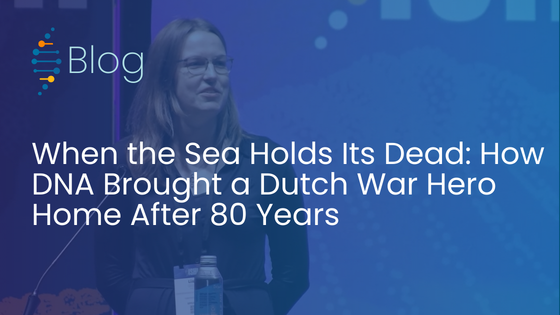
When Lisa Graaf took the stage at ISHI 36, she had a story to tell about a mandible that had waited 19 years for a name. It was broad and heavy—chunky, as an NFI anthropologist would later describe it—when fishermen hauled it from the North Sea in 2003. Golden inlays glinted from several teeth, evidence […]
Advancing Forensic Genetic Genealogy with Hybridization Capture: A High-Density SNP Approach to Genotyping Complex Samples
Design and validation of a 1.2M SNP panel for distant kinship analysis presented by Brian Brunelle During the 2025 International Symposium on Human Identification, Brian Brunelle, PhD, of Daicel Arbor Biosciences presented research evaluating the performance of a novel method for high-resolution human genotyping. The approach utilizes a hybridization-capture-based target enrichment kit to enable cost-effective […]
Setting the Standard: Inside the Latest FIGG Guidelines Update

Interview written and condensed by Tara Luther, Promega. Reposted from the ISHI Report with permission. As forensic investigative genetic genealogy (FIGG) matures from pioneering technique to powerful tool, its implementation must be matched with equal measures of scientific rigor, legal foresight, and ethical care. The newly published guidelines from the NTVIC Policy and Practice Committee reflect […]
Solving a 95-Year-Old Mystery: How Forensic Genetic Genealogy Identified the Sandy Point Man
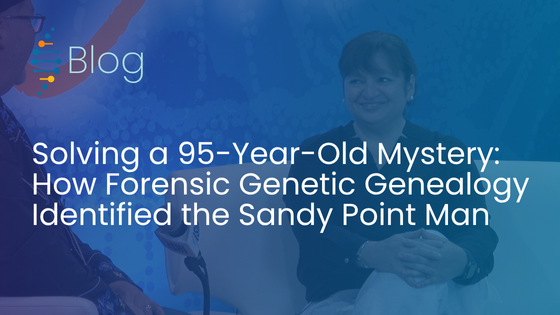
How do you identify someone who went missing nearly a century ago? At #ISHI35, Dadna Hartman, forensic scientist at the Victorian Institute of Forensic Medicine, shared the remarkable case of the Sandy Point Man—a set of unidentified human remains discovered underwater in Australia in 2017. Through forensic investigative genetic genealogy (FIGG), her team was able […]
A Virtual Global Team Solving Cold Cases with Forensic Investigative Genetic Genealogy
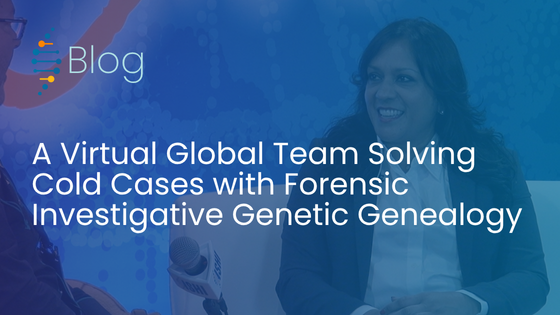
What if forensic investigative genetic genealogy (FIGG) could work across time zones—solving cases 24/7? At ISHI 35, Runa Daniel shared the groundbreaking work of the first-ever Virtual International FIGG Team, developed in partnership with the Victorian Institute of Forensic Medicine and the Australian Federal Police. This global network of forensic scientists, law enforcement, and intelligence […]