
Under the Microscope – Jennifer Cihlar

Massively parallel sequencing (MPS) technologies have been extensively evaluated by forensic genomic Research and Development laboratories for the past ten years. Results from these studies have routinely demonstrated the benefits afforded by use of these enhanced technologies and have helped progress the adoption of MPS in forensic genomic laboratories that process biological evidence. The commercial […]
The Missing Piece Episode 4: Shawna Beth Garber (Grace Doe)
In December 1990, a couple walking on a rural road in Southwest Missouri discovered the decomposed remains of a young woman. She had been hog-tied and dumped next to an abandoned farmhouse. Detective Howard was told that it would be only by the “Grace of God” that they could find out who she […]
Previewing the Posters of Our ISHI Student Ambassadors: Haley Fallang

DNA extracted from human skeletal remains is often of poor quality and/or low quantity. However, extracted DNA is often vital to determining the identity of an individual, particularly in forensic or missing persons cases. During her poster presentation at ISHI 32, Haley Fallang will examine low quality DNA extracted from degraded, historic human remains […]
This Week in Forensic Science
No one has hours to scour the papers to keep up with the latest news, so we’ve curated the top news stories in the field of Forensic Science for this week. Here’s what you need to know to get out the door! ‘Forensics Stop People Getting Away with Murder’ (BBC News – 8/12/2021) When […]
Under the Microscope – Laurence Devesse
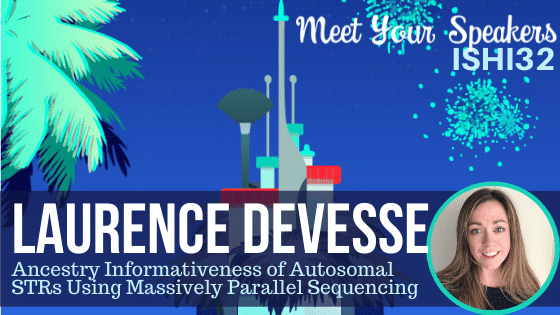
The ability to estimate the geographic ancestry of a donor from a forensic sample can be of vital importance for so called “no-suspect, no-hit” cases. It is a tool that can provide information to law enforcement and enable prioritisation of specific lines of enquiry. Traditionally, this has relied on the use of specific ancestry informative […]
Under the Microscope – Dane Plaza
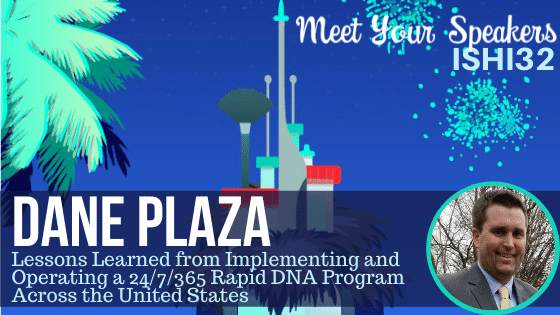
Rapid DNA technology can provide investigators with real-time investigative information, enhance border security and public safety, aid in prevention and detection of human trafficking, and provide identifications in mass casualty events. While Rapid DNA was designed for operation by non-technical field personnel, it is important to be implemented properly with the complementary support of trained […]
Previewing the Posters of Our ISHI Student Ambassadors: Nidhi Sheth

Interpreting mixture samples from a bulk pipeline is arduous since the signal is a cacophony of low-fidelity fluorescence from noise, artifact and incomplete allele signal from an unknown number of contributors. The resultant electropherograms (EPGs) are sometimes so complex as to require significant computational power to complete the interpretation. An alternate to the bulk-processing pipeline […]
This Week in Forensic Science
No one has hours to scour the papers to keep up with the latest news, so we’ve curated the top news stories in the field of Forensic Science for this week. Here’s what you need to know to get out the door! Woman’s DNA Helps Convict Her Father for Rape (BBC News – […]
Under the Microscope – Curt Hewitt
For the past three years, Signature Science has been working on the IARPA PROTEOS program to demonstrate that protein sequencing can successfully be used for human forensic identification for samples where DNA was either absent or degraded, specifically touch samples. Together with the University of North Texas Health Science Center and The Ohio State University, […]