Two FLA members from different states sent the Forensic Leadership Alliance a version of the same question, working at different points in their careers. How can leaders bridge generational gaps while still mentoring new staff into confident professionals? What strategies actually work when people on the same team think differently about how the work gets done?
It’s a question most lab leaders are working on quietly. The FLA mentors who took it up didn’t start with generational characteristics or conflict-management training. They started with what the gap actually is, and what it isn’t.
Say Why Out Loud
Dr. Ray Wickenheiser’s first move is one a lot of leaders skip. He doesn’t try to bridge the gap by pretending it isn’t there, or by adopting the language of a younger generation to “look cool.” He acknowledges the difference directly, then makes the work of leadership visible.
That work, as he describes it, is articulation. Saying out loud why the lab does what it does. Why a particular protocol exists. What motivates him personally. What he thinks the mission requires of everyone in the room. The point isn’t that newer staff don’t understand the work. It’s that they can’t share a sense of purpose with their leadership if their leadership never names it.
“We’re on a shared mission. It’s a critically important mission and everyone wants to be part of that.”
— Dr. Ray Wickenheiser
He also notes that the conversation takes longer than most leaders budget for. Newer analysts arrive with skills, energy, and a genuine sense that the work matters. What they don’t arrive with is the accumulated context behind a lab’s decisions: why a particular protocol developed the way it did, what it cost to establish it, how a specific caseload connects to families waiting on results. That context doesn’t transfer on its own. Wickenheiser’s point is that the conversation is worth the time, because when it lands, the shared mission becomes real rather than something mentioned in orientation and never revisited.
The other half of the equation is asking the same of newer analysts. Where do they want to fit in? What’s important to them? What are they bringing back from their university programs that the lab doesn’t already have? Wickenheiser is direct about what that mix produces: the combination of newer and more experienced perspectives is what actually makes a team stronger. Not something to manage around.
And Then Learn From Them
Julie Sikorsky’s contribution sits on top of Wickenheiser’s, and goes one step further. Letting newer staff speak isn’t the same as actually being shaped by what they say. Hearing them out builds trust. Adjusting based on what you’ve heard is what completes the loop.
“Maybe also from our perspective, try and learn something from that. You know, not everybody does it the same way. And that’s okay.”
— Julie Sikorsky
She gets specific. Newer analysts sometimes track their time carefully, to the minute. That can register to an older generation as a warning sign, someone watching the clock, not fully invested. Sikorsky’s read is that it might mean something else entirely, and that a curious question is more useful than a quick conclusion. How someone structures their attention says something about how they were trained to work. Some of it is stylistic. Some of it might turn out to be a better approach to something the lab has been doing one way for years. You don’t know until you ask.
Her broader point is that the stress labs feel around generational difference often comes from leaders treating it as friction to manage rather than information to engage with. When newer staff feel genuinely heard, that friction tends to drop. When they don’t, it compounds, and the gap that looked like a difference in work style starts to look like a problem with the team.
About the Forensic Leadership Alliance
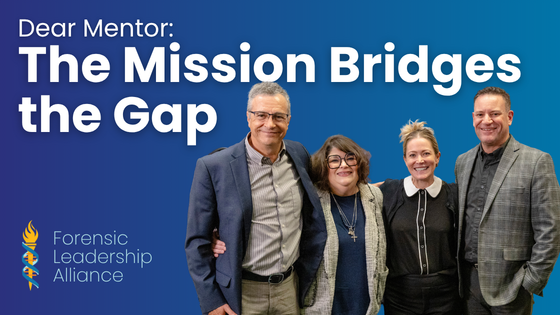
The FLA was created to give forensic lab leaders access to peer mentorship and practical tools that aren’t easy to find elsewhere. John Collins, Dr. Pamela Marshall, Julie Sikorsky, and Dr. Ray Wickenheiser have been working together since 2020 on leadership development for forensic scientists, with a focus on coaching, mentorship, and team empowerment.
Questions submitted to the FLA mentors are addressed directly, without softening the complexity of what forensic lab leadership actually involves. Topics span managing generational dynamics, navigating change, delegation, public engagement, and succession planning. These are the kinds of challenges that rarely appear in formal training but come up constantly in labs.
Join the Alliance
FLA members receive access to exclusive written and video content, one-on-one coaching sessions at ISHI, and a free leadership resource guide. Membership is free and open to forensic science professionals at any stage of their leadership path.
The FLA also hosts a full-day workshop at ISHI 37 on October 26, 2026 in Providence, Rhode Island. This year’s topic is succession planning as a product of intentional leadership culture: what it looks like when future leaders step forward because they want to, not because they were pressured.
The capacity for critical thinking is already on your team. The conditions for it may not be.