
Critical thinking in a forensic lab isn’t something that develops on its own. It develops because someone created the conditions for it, and those conditions don’t appear by accident.
That’s the frame the FLA mentors brought to a recent question from the field: how can leaders cultivate critical thinking in their teams? Their answers weren’t about instruction. They were about environment, what lab leaders build, model, and make safe.
Give Them Something to Design, Not Just Execute
Dr. Pamela Marshall’s approach starts before instrumentation enters the picture. Rather than walking newer analysts through protocols step by step, she builds in scenario-based exercises that require them to make decisions out loud, prioritizing evidence, sequencing steps, explaining their reasoning before they’ve touched anything.
The value of that approach is that it separates procedural knowledge from analytical judgment. A well-trained analyst can follow a protocol. A well-developed analyst can tell you why that protocol makes sense for this particular case and what they’d do differently if the evidence looked different. Marshall’s scenarios are designed to build the second kind of competence, not just the first.
“These are smart people. They’ve gotten degrees for various reasons. We want to make sure that we train them to continue to think.” — Dr. Pamela Marshall
She also points to something lab leaders sometimes treat as optional: staying current with the literature. Forensic science moves quickly, and analysts who aren’t reading aren’t just missing new methods. They’re missing the evolving standards their work will eventually be measured against. Marshall makes journal clubs and current articles a regular expectation, with questions that bring the reading back into team conversation.
Ask Why Until the Logic Appears
Julie Sikorsky’s contribution is simpler in form and harder in practice. When an analyst makes a decision, ask why. Then ask why again. Not to challenge them, but to help them surface the reasoning they’re already using and can’t yet articulate clearly.
Newer analysts often know more than they can explain. They’ve internalized steps from training without fully connecting them to the underlying logic. Sikorsky’s “why” habit is a way of drawing that logic out, linking the steps to the reasoning so the analyst can own both. It also builds exactly the kind of articulation that holds up when a defense attorney asks the same question in a courtroom.
“Asking the why behind it. Why are you making those decisions? What is it about this? Why does this look like it? Just follow up with the why, why, why, why, why. It really helps to link the things together and take that path down.” — Julie Sikorsky
Remove the Penalty for Thinking Out Loud
John Collins reframes the question in a way that’s worth sitting with. When critical thinking seems absent on a team, the instinct is to look for a training gap. Collins argues the more common culprit is a culture gap.
Analysts who appear not to think critically often can. They’ve just learned that it’s risky to do it visibly. In labs where being wrong carries a social penalty, or where questions are read as signs of incompetence, people stop raising them. The result looks like an inability to think critically. It isn’t.
“It’s easy to mistake fear of critical thinking with an inability to think critically. Sometimes people appear to not be able to think critically, not because they can’t, but because they’re afraid to. They’re afraid of having their hands smacked. They’re afraid of looking bad.” — John Collins
The fix isn’t a training program. It’s a deliberate effort to create low-stakes situations where analysts can explore ideas, take positions, and be wrong without consequence. Collins calls these “safe opportunities,” structured moments where the point is thinking, not performing. When those exist, leaders often discover that their team’s analytical capacity was there all along.
About the Forensic Leadership Alliance
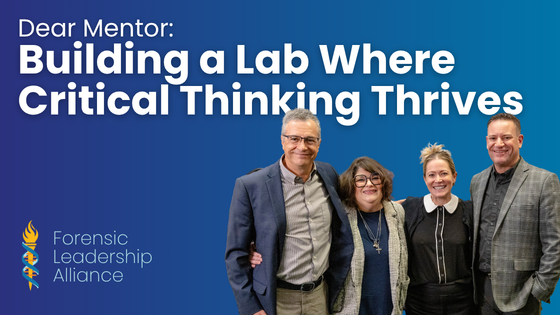
The FLA was created to give forensic lab leaders access to peer mentorship and practical tools that aren’t easy to find elsewhere. John Collins, Dr. Pamela Marshall, Julie Sikorsky, and Dr. Ray Wickenheiser have been working together since 2020 on leadership development for forensic scientists, with a focus on coaching, mentorship, and team empowerment.
Questions submitted to the FLA mentors are addressed directly, without softening the complexity of what forensic lab leadership actually involves. Topics span managing generational dynamics, navigating change, delegation, public engagement, and succession planning. These are the kinds of challenges that rarely appear in formal training but come up constantly in labs.
Join the Alliance
FLA members receive access to exclusive written and video content, one-on-one coaching sessions at ISHI, and a free leadership resource guide. Membership is free and open to forensic science professionals at any stage of their leadership path.
The FLA also hosts a full-day workshop at ISHI 37 on October 26, 2026 in Providence, Rhode Island. This year’s topic is succession planning as a product of intentional leadership culture: what it looks like when future leaders step forward because they want to, not because they were pressured.
The capacity for critical thinking is already on your team. The conditions for it may not be.