
Burnout in forensic labs is a leadership problem — but not always for the reason leaders assume.
The instinct is to look at the caseload. The backlog. The mandatory overtime and the court deadlines and the sample volume that doesn’t match staffing levels. Those things are real. But according to the mentors of the Forensic Leadership Alliance, they’re often not the root cause.
The Isolation Problem
John Collins has spent years coaching forensic science leaders, and his read on burnout is one that most labs aren’t having out loud.
“People are more likely to be burned out by isolation than they are the work, but they think they’re burned out by the work.” — John Collins
High-volume environments create a specific, underappreciated hazard: they eliminate the time people spend connecting with colleagues. Execution crowds out everything else. And when connection disappears, the work feels heavier than it actually is.
For lab leaders, the implication is concrete. Creating space for socialization — even in a serious, high-stakes environment like forensic DNA — isn’t a soft benefit. It’s a retention strategy.
Collins also noted that disengagement doesn’t always announce itself.
“Leaving can be literal or figurative because people can kind of check out even though they’re still there in the lab.” — John Collins
That second kind of leaving is harder to see — and harder to recover from.
Sharpening the Axe
Dr. Ray Wickenheiser approached the same problem from a different angle: professional stagnation. When analysts are doing the same work, day after day, without development or variety, motivation erodes — not dramatically, but steadily.
“If all you’re doing is chopping wood, chop chop chop, at some point your axe gets dull. You have to take a timeout to sharpen it.” — Dr. Ray Wickenheiser
The antidote, in his view, is investment — training, conferences, exposure to new methods and technology. Not as a perk, but as a signal that the people doing this work are worth developing.
There’s an operational argument here too, not just a motivational one. Forensic science hasn’t stood still. Labs that stop investing in development don’t just risk losing staff to burnout — they risk falling behind the methods they’re supposed to be defending in court.
The Two-Way Street
Julie Sikorsky directed her response not only at leaders, but at analysts themselves. The conditions for engagement can’t be built unilaterally.
“It really is important that if the employees are feeling that way, and there’s not a whole lot of support at the top, that they do let their leadership know that they are struggling with that because we certainly put so much investment in terms of money and time into creating these analysts that we don’t want them to leave because they don’t feel heard.” — Julie Sikorsky
Burnout prevention isn’t something leaders do to analysts. It’s something built through communication in both directions — which means analysts have a responsibility to surface what they’re experiencing, even when the culture makes that feel risky.
About the Forensic Leadership Alliance
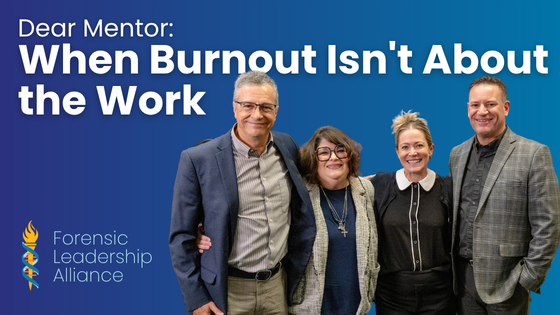
The FLA was created to give forensic lab leaders access to peer mentorship and practical tools that aren’t easy to find elsewhere. John Collins, Dr. Pamela Marshall, Julie Sikorsky, and Dr. Ray Wickenheiser have been working together since 2020 on leadership development for forensic scientists — with a focus on coaching, mentorship, and team empowerment.
Questions submitted to the FLA mentors are addressed directly, without softening the complexity of what forensic lab leadership actually involves. Topics span managing generational dynamics, navigating change, delegation, public engagement, and succession planning — the kinds of challenges that rarely appear in formal training but come up constantly in labs.
FLA members receive access to exclusive written and video content, one-on-one coaching sessions at ISHI, and a free leadership resource guide. Membership is free and open to forensic science professionals at any stage of their leadership path.
The FLA also hosts a full-day workshop at ISHI 37 on October 26, 2026 in Providence, Rhode Island. This year’s topic: succession planning as a product of intentional leadership culture — what it looks like when future leaders step forward because they want to, not because they were pressured. The caseload isn’t going anywhere. The question is what leaders build around it.