
Massively parallel sequencing (MPS) has long promised to transform forensic DNA analysis. The ability to interrogate more loci, generate richer allele data, and multiplex dozens of samples in a single run represents a compelling leap forward from capillary electrophoresis (CE). Yet adoption in routine casework has remained limited—held back by complex, multi-step library preparation workflows that demand significant hands-on time and technical expertise.
That barrier is now removed. The IDseek® OmniSTR™ Global Kit from NimaGen uses the revolutionary Reverse-Complement PCR (RC-PCR) technology to deliver a single-reaction, closed-tube MPS library preparation workflow for autosomal STR profiling. By reducing library prep to three steps—react, cleanup, sequence—IDseek® brings the power and depth of MPS within reach of every forensic laboratory, without sacrificing the simplicity of CE.
“The unmatched simplicity, robustness, sensitivity and safety of IDseek® now facilitates a routine MPS application, hardly exceeding hands-on time of CE.”
Why Routine Forensic MPS Has Been Out of Reach
The fundamental challenge with MPS library preparation has always been workflow complexity. Standard library prep methods require end-repair, A-tailing, adapter ligation, purification, normalization, quantification, pooling, and sequencing—a series of eight or more discrete steps that introduce multiple opportunities for error, cross-contamination, and sample mix-up.
Compare those workflows to the streamlined steps of the IDseek® RC-PCR approach:
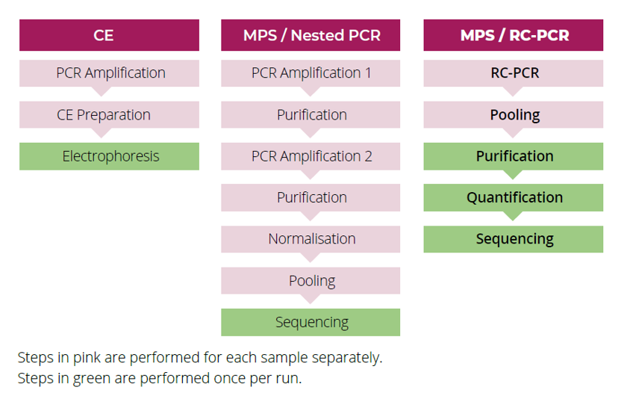
As the table illustrates, the IDseek® RC-PCR workflow reduces the workflow significantly, directly translating to shorter hands-on time, fewer pipetting steps, and a lower risk of pre-analytical error.
How RC-PCR Works: A Single Reaction That Does it all
At the heart of the IDseek® system is an elegant molecular engineering solution. Each IDseek® kit consists of two components: an assay-specific RC-PCR Probe Panel with Master Mix, and an Index Primer Plate containing pre-spotted, dehydrated Unique Dual Index primers.
The workflow begins by combining the probe panel with the Master Mix, dispensing it into the IDX plate, adding sample DNA, and starting the RC-PCR thermocycling program. During the first annealing step, the reverse-complement probe tails hybridize to the IDX primer tails. The IDX primers are then extended with target-specific sequences, synthesizing functional indexed primers that incorporate Illumina® adapters directly. In subsequent cycles, target loci are amplified while additional primers are continuously generated—producing a fully indexed, Illumina®-compatible MPS library within a single closed-tube reaction.
Because primers are synthesized during the reaction rather than pre-added, primer concentration remains proportional to target availability. The result is a library with high specificity, excellent sensitivity, and balanced amplification across all target loci.
Equally important is when indexing occurs. Sample-specific unique dual indexes are incorporated during the initial amplification reaction rather than added in a separate downstream step, tagging each sample with its identifying barcode before any pooling or post-PCR handling. This early indexing establishes a chain of molecular custody from the first thermal cycle further reducing opportunities for sample misattribution.
The closed-tube design is a critical safety feature. Once the sample is added and the plate is sealed, there is no further manipulation until the cleanup step. This dramatically reduces the risk of PCR contamination, sample swapping, and pipetting error—concerns that are paramount in forensic casework environments.
IDseek® OmniSTR™ Global: Comprehensive Coverage for US and European Databases
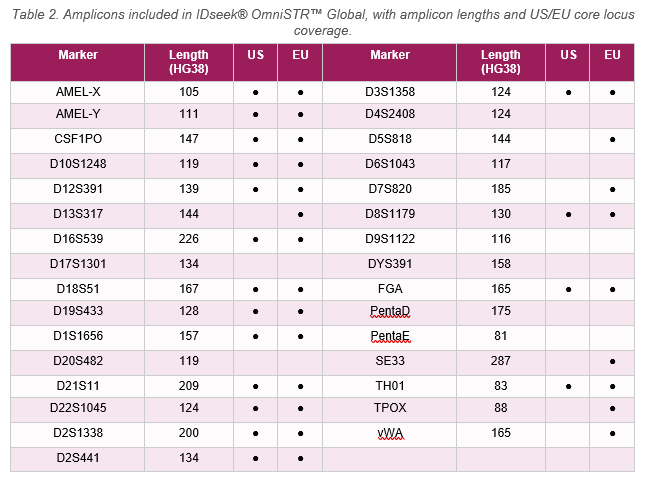
The OmniSTR™ Global Kit is the flagship autosomal STR profiling product in the IDseek® portfolio. It is a single-reaction, multiplex library preparation kit that covers all US and European expanded core loci, including SE33, D4S2408, D6S1043, D9S1122, D17S1301, D20S482, PentaD, PentaE, and DYS391.
All amplicons have been specifically designed for short amplicon lengths—maximizing performance on degraded, low-template, and challenging casework samples—while retaining the most informative sites in flanking regions to ensure compatibility with established allele frequency databases.
Validated Performance Across Forensic-Relevant Challenges
Two scientific articles showcase concordance, direct PCR performance, PCR inhibition resistance, sensitivity, specificity, repeatability, and reproducibility demonstrating the performance of IDseek® OmniSTR™ Global Kit for a forensic casework workflow (de Jong et al., 2025, van der Gaag et al., 2025).
Interlocus Balance
Samples prepared with the OmniSTR™ Global Kit display strikingly uniform amplification. Normalized read depth data at 1,000 pg input DNA demonstrate even distribution of reads across all 31 loci, with no individual marker dominating or dropping below detection. This interlocus balance is critical for accurate genotyping in casework, where variable amplification can lead to dropout or stutter artifacts that complicate interpretation.
Sensitivity
The kit demonstrates concordant profiles down to 31 pg of input DNA, with a portion of alleles falling below the analytical threshold (AT) at the lowest input levels—consistent with expected stochastic effects at low DNA sample templates. For routine casework with quality reference samples, the kit reliably produces complete profiles from 125 pg and above.
PCR Inhibition
Inhibition tolerance was evaluated for five inhibitor types across four concentrations each. The kit demonstrated no performance impact from bacterial DNA or indigo carmine at any concentration tested, and maintained complete allele recovery in the presence of humic acid even at the highest concentration. With Hematin and Tannic acid, allelic dropout was only observed at the higher concentrations.
Heterozygous Balance
The kit produces excellent heterozygous balance across loci in both reference samples and direct PCR. With 97.80% of alleles showing a heterozygosity balance of 0.6 or higher, and 77.76% between 0.8 and 1.0, the data supports reliable mixture deconvolution and reduces the risk of allelic imbalance artifacts during probabilistic genotyping.
On-Target Efficiency
On-target read percentages remain high across a broad range of DNA inputs (15.625 pg to 10,000 pg), meaning sequencing capacity is efficiently utilized rather than wasted on off-target sequences. This efficiency directly reduces per-sample sequencing costs and allows more samples to be batched per sequencing run.
A Complete Forensic MPS Ecosystem
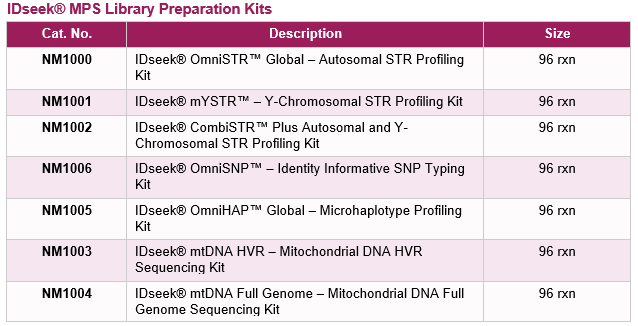
OmniSTR™ Global is the flagship product in a comprehensive forensic MPS portfolio. Because all IDseek® kits are built on the same RC-PCR chemistry and universal index plate system, libraries from different kits can potentially be pooled into a single Illumina® sequencing run—maximizing flow cell utilization and reducing cost per sample. The full IDseek® portfolio covers every major forensic DNA typing application:
- IDseek® OmniSTR™ Global – Autosomal STR profiling, US and European core loci
- IDseek® mYSTR™ – Y-chromosomal STR profiling for male lineage analysis
- IDseek® CombiSTR™ Plus – Combined autosomal and Y-chromosomal STR profiling in one reaction
- IDseek® OmniSNP™ – Identity informative SNP typing with ultra-short amplicons for highly degraded samples
- IDseek® OmniHAP™ Global – Microhaplotype profiling for mixture deconvolution and ancestry inference
- IDseek® mtDNA HVR – Mitochondrial DNA hypervariable region sequencing
- IDseek® mtDNA Full Genome – Complete mitochondrial genome sequencing for highest discrimination power
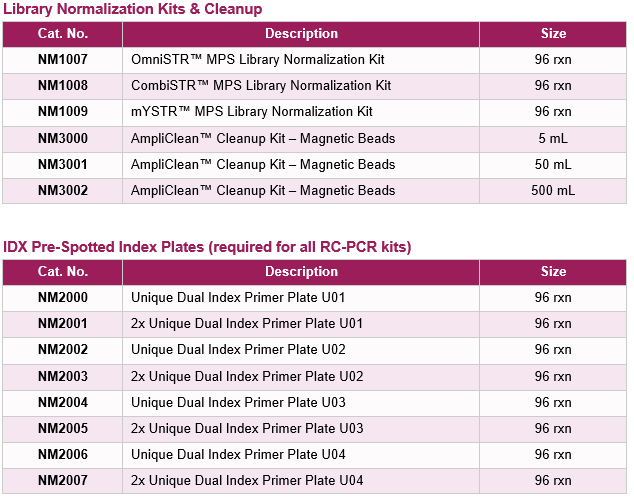
Completing the workflow ecosystem are three categories of accessory products.
- Unique Dual Index (UDI) Plates contain dehydrated, pre-spotted dual indexes in a 96-well format that can be snapped apart by column for flexible use.
- The AmpliClean™ Magnetic Cleanup Kit provides bead-based library cleanup and size selection optimized for RC-PCR libraries, available in three sizes.
- Library Normalization Kits for OmniSTR™ Global, CombiSTR™ Plus, and mYSTR™ enable read-depth normalization across samples of mixed input quantity and quality, simplifying pooling decisions before purification.
Ordering Information
IDseek® products are available globally through Promega Corporation as a non-exclusive distributor. Contact your regional Promega representative or visit promega.com to order.
A New Standard for Forensic MPS
The IDseek® OmniSTR™ Global Kit represents a genuine inflection point for forensic MPS adoption. By solving the workflow complexity problem that has kept MPS confined to specialist applications, NimaGen has created a product that is accessible, practical, and validated for the full range of forensic casework challenges.
For laboratories already invested in Illumina® sequencing infrastructure—or evaluating MPS for the first time—OmniSTR™ Global offers a compelling, low-barrier entry point. The same one-tube, single-reaction principle that makes it easy to use also makes it inherently safer, more reproducible, and more cost-effective per sample than any other MPS library preparation approach on the market today.
Combined with the deep locus coverage required for both US and European national DNA databases, the short amplicon design optimized for degraded samples, and the flexibility to multiplex multiple assay types in a single sequencing run, IDseek® OmniSTR™ Global is poised to become the new standard workflow for forensic STR profiling by MPS.
For more information, contact your Promega representative.
For Research Use Only.