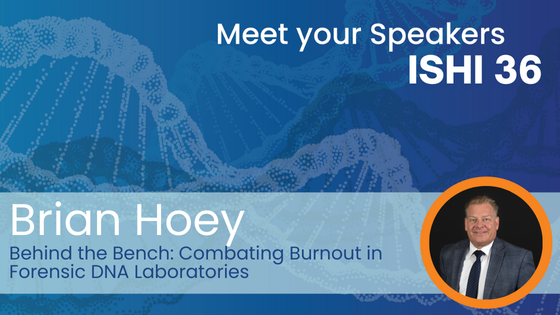
Forensic DNA analysts work at the intersection of science, justice, and relentless pressure. As caseloads grow and expectations rise, so too does the toll on the people behind the bench. Few understand this better than Brian Hoey, whose career has spanned casework, leadership, and deep engagement with the forensic community.
At ISHI, Brian will join a panel discussion on burnout in forensic science—a conversation that’s both overdue and urgent. Drawing on research, practitioner experience, and his own hard-earned perspective, Brian will explore why traditional wellness efforts often fall short and how building true resilience requires more than apps and awareness. He challenges us to rethink stress, strengthen “emotional armor,” and push for organizational cultures that support—not just demand—the workforce.
What was happening in your lab, case, or field that made this work feel urgent or necessary? What sparked this presentation?
Well, quite frankly I was asked. That said, mental health and wellness and burnout are absolutely real in forensic science—period, full stop. But here’s the paradox: we’ve invested heavily in EAPs, apps, trainings, and discussions, yet usage remains at about 5–10% nationally—and roughly 9% in my workplace. Meanwhile, mental health concerns aren’t improving—they seem to be getting worse. People feel supported in theory, but not resilient in reality. The result is a workforce that may be more aware of its struggles, but less equipped to overcome them.
This isn’t due to lack of effort—we, the community and our labs, have provided tools—but because our field, like society at large, is wrestling with deeper forces: social isolation, declining male participation, increased depression, and workplace cultures that unwittingly foster dependency rather than strength. That’s why this talk feels not just necessary but urgent—we have to shift from treating symptom awareness to building systemic resilience.
If someone walks out of your talk with one tool, mindset, or strategy—what should it be?
If there’s one thing I hope you take from this conversation, it’s this: mental health is real, and so is your capacity to strengthen it. We all face stress, trauma, burnout and emotional challenges — especially in forensic science. But we don’t have to be passive recipients of those experiences. We can build resilience. We can develop what I call ‘emotional armor.’
The resources are here — from apps to EAPs to peer support — but they only work if you use them. Think of these tools like a gym membership: having one doesn’t make you stronger — using it does. Building resilience doesn’t mean pretending things don’t hurt. It means learning how to navigate adversity without losing ourselves in it.
As neuroscientist Robert Sapolsky said “No zebra on earth running for its life would understand why the fear of speaking in public would cause you to secrete the same hormones that it is doing at that point to save its life!”: a zebra running from a lion doesn’t get ulcers — because it doesn’t relive the stress after the danger has passed. We do. And we need to recognize that part of wellness is rewiring how we respond to stress, burnout and trauma— so we can thrive, not just survive, in this demanding but deeply important work
Let’s play “myth vs. reality.” What’s one thing people think they know about the topic you’re presenting on—but totally get wrong?
Myth:
Mental health issues and burnout in forensic science are mostly caused by the job — the stress, the trauma, the caseload.
Reality:
While forensic work is emotionally demanding, many of the mental health challenges our workforce faces don’t start at the crime scene or in the lab— they walk through the door with us.
We are living through a broader mental health crisis.
Consider this:
- Depression has increased by over 60% in the past decade, affecting 1 in 8 Americans today.
- Youth loneliness has been rising steadily since the 1970s.
- Young adults (18–25) face the highest depression rates: nearly 1 in 5 suffer from a major depressive episode annually.
- Teen depression and anxiety rates more than doubled from 2010–2019, These teens get jobs in our labs.
- Emergency room self-harm visits among teenage girls rose by 188%, and about 48% for boys,
- Mental illness affects nearly 1 in 4 American adults — that would include every forensic unit, every discipline, every team.
- Women are 60% more likely than men to experience depression, and young women report the highest levels of sadness, anxiety, and hopelessness.
- The college gender gap now favors women 58 to 42, making it harder for young women to find socioeconomic and romantic matches — especially in female-dominated fields like ours.
- And men, meanwhile, are dropping out of the workforce and higher education at historic rates — a trend that contributes to rising depression, alienation, and lack of direction among young males.
- Add to that the impact of smartphones, social media, and digital isolation, and we are entering the workplace less connected, less resilient, and more emotionally vulnerable than ever before.
These pressures don’t begin in the forensic lab. But once they arrive here, they collide with the very real stress and secondary trauma of our work. That’s where things can spiral.
And yet—there’s a silver lining. If we understand that many of these challenges are brought in, not caused by the job, then we can start working on solutions that don’t rely solely on waiting for change from the outside.
We can build resilience. We can learn to regulate stress, use the resources we have, and support one another. Not by pretending the work isn’t hard — but by learning to carry it without letting it break us.
If you had unlimited time and no red tape, what’s one experiment or idea you’d chase tomorrow?
RETIREMENT!
Let’s be honest—what’s the hardest part of your work right now? What helps you stay engaged or motivated in your role—especially when things get intense?
The hardest part of my work right now is people management. Individuals often struggle to stay on task, communicate effectively, or understand their roles within a group. Structural challenges—like unclear status, norms, and cohesion—compound those issues, especially in a decentralized laboratory where strong, consistent leadership is essential. Many of our supervisors and team leads are still developing the skills needed to guide teams, make timely course corrections, and hold people accountable, and that makes coordinated progress difficult.
Many lab leaders were exceptional analysts, but the same skill sets that made someone great at the bench don’t automatically make them great at managing people or processes. We see a problem, we try to fix it—over and over—without stepping back to define the problem, assess the process, or ask the right questions. It becomes reactive management, not leadership. And without a grounding in process management or frameworks like Lean Six Sigma, it becomes very difficult to sustain progress. That lack of strategic leadership makes my job exponentially harder.
What keeps me motivated is the work itself. I believe in immersing myself in the mission, in getting things done, and in celebrating success that’s earned through effort. No success is meaningful unless you’ve put in the work to get there—and that belief continues to drive me forward, even when the path is challenging.
What is the most underrated skill in forensic science?
The ability to rapidly sort through complex, often overwhelming volumes of information and reach sound, unbiased, and ethical conclusions is one of the most underrated—and essential—skills in forensic science. We’re not just scientists; we operate at the intersection of science and the criminal justice system. Our work must hold up to scrutiny from law enforcement, attorneys, judges, legislators, community leaders, advocates, and the public.
We use scientific methods to pursue truth, but we must also navigate a diverse network of stakeholders—each with different needs, expectations and pressures. The ability to stay grounded in the science, maintain impartiality, and communicate findings clearly and ethically across that spectrum is both rare and vital. It’s not flashy, but it’s foundational to everything we do.
What advice would you give someone who’s just starting out in forensic DNA—or thinking about presenting at ISHI someday?
Get involved—fully, enthusiastically, and without hesitation. Immerse yourself in every opportunity you can: validations, method development, literature, training, and conferences. Even if you have to fund some of it yourself, the connections you’ll make and the knowledge you’ll gain are invaluable. Collaboration and community are the heartbeat of forensic DNA science.
And if you’re thinking about presenting at ISHI—do it! Put yourself out there. Science is built on questioning, testing, and discussion. Presenting your work invites feedback, sometimes debate, but always growth. Whether your thesis is challenged or affirmed, you’ll become a better scientist through the process.
Sharing your work is how we advance our field. It’s also how you start building the resilience this profession demands (see above). There’s no better way to grow than to engage—fully and openly—with your peers and your science.
What roles do collaboration, mentorship, or community play in your success as a scientist?
Collaboration, mentorship, and community have shaped not only my career as a scientist, but also who I am as a person. Getting fully immersed—participating in conferences, presenting research, joining panels, serving on committees, and holding board positions in professional organizations like MAFS and ASCLD—has given me both depth and breadth of knowledge. More importantly, it’s given me a network of colleagues who’ve become lifelong friends and trusted advisors.
Through these connections, I’ve learned, grown, and sometimes been challenged—and that’s been invaluable. There were moments when debate put me in my place, and I’m better for it. The forensic science community is small but strong, and the support, guidance, and camaraderie I’ve found there have played a major role in my growth, my confidence, and my success.
What’s the weirdest or most unexpected way your work has shown up in daily life?
Surprisingly—or maybe not—my work in forensic science has deeply shaped how I handle everyday life. Years of casework, presenting research, joining panels, serving on boards, and engaging in debate have taught me how to communicate clearly, listen actively, and disagree without being disagreeable. But more than that, it’s built something essential: resilience and confidence.
When life throws curveballs—whether it’s a flooded basement, a fender bender, or raising teenagers—I don’t panic. I pause, take a breath, and approach the problem like I would a case: form a hypothesis, test it, look at the data, and work toward a solution—work the process! Forensic science has trained me to stay calm under pressure and to trust process over panic. That mindset has carried over into my personal life more than I ever expected—and I’m grateful for it every day.
Complete the sentence: ISHI is the one place where ________.
I belong! — to collaborate and grow.