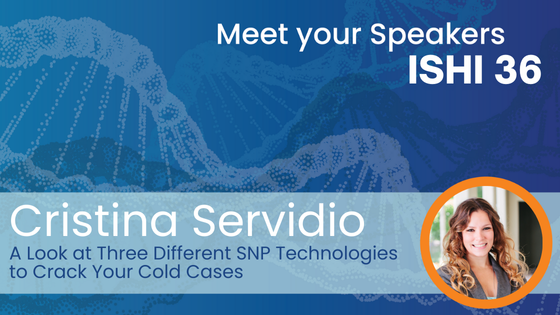
Cold cases can linger for decades, waiting for the right tools to bring answers forward. For Cristina Servidio, Senior DNA Analyst at DNA Labs International, that challenge comes down to one question: when traditional STR testing fails, what else can DNA reveal?
At ISHI, Cristina will present “No More Mister ‘Nice Guy’: A Look at Three Different SNP Technologies to Crack Your Cold Cases.” Drawing on real casework, she’ll show how single nucleotide polymorphism (SNP) testing can generate new investigative leads when CODIS comes up empty—and why choosing the right SNP approach matters. Whether it’s targeted sequencing, array testing, or whole genome sequencing, Cristina’s message is clear: the path forward depends on the evidence itself.
What was happening in your lab, case, or field that made this work feel urgent or necessary? What sparked this presentation?
Traditional STR testing has been the gold standard of the forensic DNA community for a long time. However, even when you do manage to get a profile, if there is no hit in the database, the case can come to an immediate halt. We wanted to find a way to generate new leads and potentially solve these cases where we know the DNA is there. We have the STR profile, but what else can the DNA tell us that we don’t know from our standard testing? Next generation sequencing and forensic investigative genetic genealogy has been the star of forensic DNA conferences for the past few years, but many scientists still don’t know that there are options as to which type of testing is selected and which is best may vary based on the case.
If someone walks out of your talk with one tool, mindset, or strategy—what should it be?
It’s my hope that everyone will walk out of this presentation with a basic knowledge of which SNP technologies are available for their cases and with the hope that one of these tools may be able to answer questions for a case they have worked on.
Let’s play “myth vs. reality.” What’s one thing people think they know about the topic you’re presenting on—but totally get wrong?
When we first started looking into SNP technologies years ago, the only companies who were really doing it were non-forensic at the time and did not have the same limitations that we have as far as evidence goes. So they would request 20-50ng of DNA to use to generate the SNP profile. Well as we all know, we don’t typically see that large of an amount of DNA in our casework with the exception of standards or intimate samples. That’s where the technology has changed – the amount of DNA needed to generate these profiles is about the same you would need to generate an STR profile and you can work off of the same extract. Even in highly degraded samples, we are seeing successes!
What is the most underrated skill in forensic science?
Communication is one of the top skills in our field. If we cannot communicate our results in an accurate way that is easy to understand, then we lose the value in those results. I’m sure we’ve all seen that episodes of Bones or Law and Order where the expert sounds very monotone and is speaking using very technical terms. It may make you sound smart, but often times, the jury is going to tune you out or fall asleep.
What advice would you give someone who’s just starting out in forensic DNA—or thinking about presenting at ISHI someday?
Go for it! One of the scariest moments of my life was presenting at ISHI at the first time, but I was so glad I did it. If you are just starting out, you are so lucky to be in the middle of a very exciting time for our field! New technologies are constantly being released and there is always something to learn.
What roles do collaboration, mentorship, or community play in your success as a scientist?
Collaboration is the key to all of our successes as scientists. Take a case you are working on in the laboratory as an example. Even if you are at a laboratory that works an entire case from start to finish, you rely on a number of people each day to ensure that the work is done properly including technical reviewers, management, quality assurance personnel, instrument technicians and so on. No matter your title or position, you are an important piece of the puzzle in the forensic DNA community.
Complete the sentence: ISHI is the one place where ________.
ISHI is the one place where forensic DNA is highlighted in a fun and interactive atmosphere.