
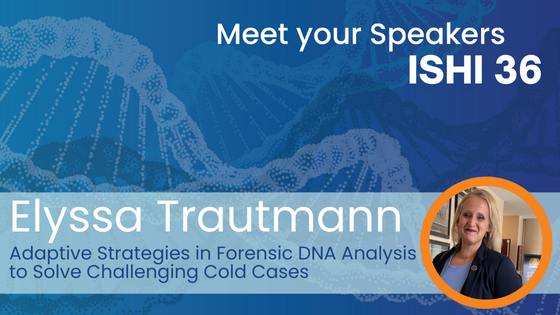
Cold cases often carry the weight of time, unanswered questions, and evidence that doesn’t always fit neatly into today’s standard workflows. For Elyssa Trautmann, a DNA analyst with the Florida Department of Law Enforcement, that challenge has become a calling. Guided by the wisdom of veteran colleagues and the encouragement of trusted mentors, Elyssa has learned that sometimes solving the “unsolvable” means knowing when—and how—to adapt.
At ISHI 2025, Elyssa will share her presentation, “Never Fear—An SOP Deviation Is Here!”, where she explores how small, documented adjustments to standard procedures can breathe new life into cold cases. Through real-world examples, she’ll show how thinking outside the box (with the right approvals and documentation in place) can open doors to answers long thought out of reach.
What was happening in your lab, case, or field that made this work feel urgent or necessary? What sparked this presentation?
My lab is very fortunate to have many senior analysts, so during my time at the Florida Department of Law Enforcement I learned numerous techniques and approaches to casework from these veterans. These analysts also taught me different ways to look at cases to avoid tunnel vision. Many labs do not have the “generational knowledge” that can help when working on older cold cases and I thought a case study presentation could be an interesting way to share that insight.
If someone walks out of your talk with one tool, mindset, or strategy—what should it be?
Talk with your technical leader about your case if it is complicated! The technical leaders see the gambit of weird and unusual evidence and may have a way to help guide you. The SOP is a tool we all follow to ensure quality, but there are enhancements that can be made and documented to help variations in casework (of course with the proper approval and documentation 😊).
Let’s play “myth vs. reality.” What’s one thing people think they know about the topic you’re presenting on—but totally get wrong?
That there is no wiggle room in the SOP. 99.99% of the time following the direct instructions of your SOP is how casework should operate, but there can be documented circumstances of deviations to the procedure to benefit a case. We cannot write procedures for every single scenario, but documented, approved exceptions do exist to help with the odd case or evidence.
If you had unlimited time and no red tape, what’s one experiment or idea you’d chase tomorrow?
Often the ideas or experiments don’t come to me unless I have a piece of evidence in front of me. This is exactly what my presentation is about and hopefully I can spark some innovation to other analysts if they have a troubling case waiting at work. But, if I had capabilities to do so I would love to find a way to make a container that I could extract a larger cutting size. I am often limited to the size of a processing sample tube when deciding my cuttings size for evidence.
Let’s be honest—what’s the hardest part of your work right now? What helps you stay engaged or motivated in your role—especially when things get intense?
The hardest part of my work right now, is trying to juggle all the extra tasks that come with being a DNA analyst. I really enjoy just working on casework, whether it be extracting, screening an item of evidence or something hands on in the lab. One of the main factors that keeps me motivated is obtaining a good DNA result with an advanced technique. Analysts can often hesitant performing extra “hands on” of a sample, but sometimes it takes a little bit more manipulating to obtain results in a case. Finding balance and taking time to decompress is also difficult in the day-to-day work. Its easy to want to dive into your case, but turning off your brain at home is a necessary break.
What is the most underrated skill in forensic science?
Not getting tunnel vision and thinking outside the box. In examining cold cases it can be easy to be frustrated by prior analysis and evidence that doesn’t react the same with our testing methods due to its age. The cold cases require extra TLC that can affect efficiency workflows and encouraging that extra time can be beneficial for the analyst and the case.
What advice would you give someone who’s just starting out in forensic DNA—or thinking about presenting at ISHI someday?
Follow your own path and don’t compare yourself to anyone. I did not think my path would be working on cold cases, but that is what brings me the most satisfaction within my career. I have been lucky enough to experience many aspects of working in a forensic lab: training, validations, performance checks, audits-but working on cold cases has been my #1. Everyone in their career should follow different paths and then we all can do what we are best at achieve the same common goal.
What roles do collaboration, mentorship, or community play in your success as a scientist?
These are the biggest factors that play a role in my success as a scientist. I am so lucky to have my TL’s, veteran analysts and a supportive supervisor as mentors in my career. I do not think I would have been as successful if I hadn’t received the encouragement, trust and confidence of these people. I have had numerous conversations with my TL about utilizing the SOP to my advantage and she would be the one who sometimes suggested a slight tweak to my strategy. These “enhancements” to our SOP would be the ticket that helped me obtain a profile to solve a case.