
In regions affected by conflict, survivors of sexual violence often face a second injustice: the absence of forensic systems that can hold perpetrators accountable. For Vanessa Lynch, founder of DNAforAfrica, that gap is not just a technical challenge—it’s a moral one.
At ISHI, Vanessa will present “Samples2Solutions: Advancing Forensic DNA Capacity to Support Survivors of Conflict-Related Sexual Violence in Africa.” Inspired by the resilience of women at Panzi Hospital in the Democratic Republic of Congo, Vanessa launched this initiative in partnership with the University of Cape Town and Panzi Hospital to build forensic DNA capacity where it’s needed most. From training forensic nurses to developing survivor-centered procedures and establishing operational profiling capability, the project demonstrates how DNA can be more than evidence—it can be a pathway to justice, dignity, and systemic change.
What was happening in your lab, case, or field that made this work feel urgent or necessary? What sparked this presentation?
I watched a Netflix documentary called City of Joy which showed the incredible resilience and courage of women who had survived unspeakable acts of conflict-related sexual violence (CRSV) in the DRC, and who were helped and healed by the remarkable Dr. Denis Mukwege and his team at Panzi Hospital. But I couldn’t see where accountability lay. While survivors’ health and recovery were prioritised, justice seemed absent and there seemed to be a lack of forensic systems available to identify these perpetrators.
Cue DNA…I contacted Panzi Hospital who, together with my colleagues at UCT, launched the Samples2Solutions pilot project in response to the need for forensic DNA capacity in cases of CRSV in the DRC. This project aims to find solutions to help close that gap through building practical DNA profiling capability in partnership with Panzi Hospital and UCT.
If someone walks out of your talk with one tool, mindset, or strategy—what should it be?
That CRSV is our collective responsibility. The women and children affected are not random victims, they are targeted because of wars fueled by the demand for precious minerals like cobalt and coltan, found in this region, which power our smartphones and laptops. As long as we rely and use these technologies, we can’t look away from the human cost paid by survivors: rape is being used as a weapon of war. Accountability starts with acknowledging that connection.
Let’s play “myth vs. reality.” What’s one thing people think they know about the topic you’re presenting on—but totally get wrong?
Myth: “This is happening far away in Africa-it doesn’t affect me.”
Reality: As I mentioned above, the scarce minerals (such as coltan and cobalt) are mined in these regions and are fueling these conflicts. As long as coltan and cobalt are essential to the smartphones, laptops, and electric cars which we use every day, survivors of CRSV are paying the human cost for our digital convenience. Just as our smartphones connect us, so are we all connected to this issue, and accountability begins with recognising that uncomfortable truth.
If you had unlimited time and no red tape, what’s one experiment or idea you’d chase tomorrow?
OH, there are so many things! But if I had to choose one, I’d work to establish an integrated DNA database for Africa, supported by regional FSLs. Why? Because I believe a unified approach to DNA data processing and sharing, for both justice and humanitarian purposes , would significantly strengthen forensic capacity across our region and help ensure justice is delivered more efficiently. With so much migration, cross-border crime, human trafficking and so many unidentified decedents on our continent, it makes sense to pool our resources to help identify offenders and support humanitarian efforts to name and repatriate the missing and the dead.
Let’s be honest—what’s the hardest part of your work right now? What helps you stay engaged or motivated in your role—especially when things get intense?
The hardest part is probably the persistent lack of resources and political will to build sustainable forensic capacity in Africa, despite the very obvious and urgent need for it. It’s frustrating to hear of survivors waiting years (if they’re lucky) for justice, families unable to retrieve their loved ones, and decedents being buried without a name, all while the tools to support them exist but aren’t prioritised. After 21 years, I’m still advocating for policies that strengthen and support the capacity of forensic science laboratories across the continent. If you stop hearing from me, that may mean I’ve given up, but let’s hope it never comes to that!!
What is the most underrated skill in forensic science?
As a lawyer and not a scientist, I think the ability to communicate complex scientific concepts in a clear and simple way in court is a superpower! It’s essential because it means when people understand the science, they can trust it.
What advice would you give someone who’s just starting out in forensic DNA—or thinking about presenting at ISHI someday?
I’m going to answer this from a purely ‘from Africa’ perspective because I canvassed this recently in an open letter published in FSIG : “Towards a more supportive and inclusive forensic science community” (DOI: 10.1016/j.fsigen.2023.102997). My advice: seek out opportunities to present at major platforms like ISHI, but also advocate for funded access. Travel and subsistence support can be a game-changer for young scientists, especially those from low-resource regions -even the expense of travelling from the airport to the meeting venue is prohibitive, let alone affording airfare and subsistence at the destination. I think that service providers and professional societies should do more to create accessible pathways to these types of events through sponsorships and fellowships.
What roles do collaboration, mentorship, or community play in your success as a scientist?
Following on from my answer to Q7, equally important is mentorship. In the same article I proposed that if just 10 respected authors committed to mentoring, and one journal offered space to showcase their mentees’ work, it could give 10 young scientists across Africa the chance to be guided, supported, and heard without condition. That kind of investment can open doors, amplify new voices, and help build the future of forensic science in a truly inclusive way.
What’s the weirdest or most unexpected way your work has shown up in daily life?
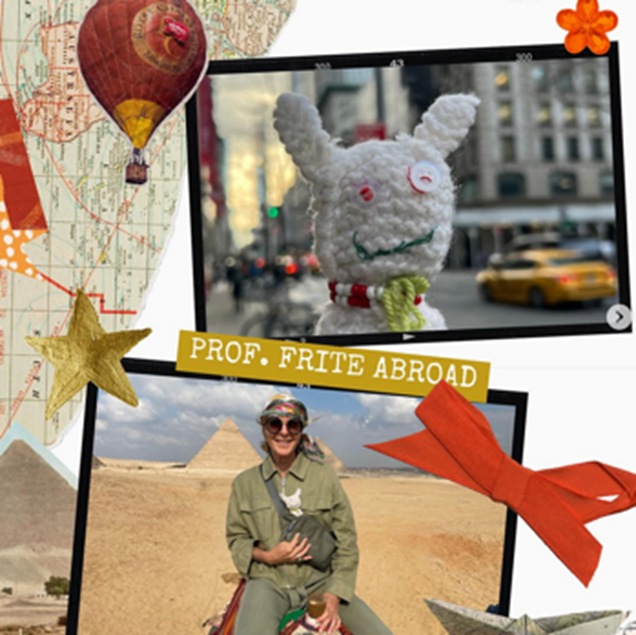
I love to write children’s books! My work in forensic has inspired me to create a DNA series about a character named Professor Frite. In 2020, my daughter knitted me the original ‘Frite’ from leftover wool on chopsticks, and he became my constant travel companion, joining me on forensic missions across the world, from the Pyramids of Giza to Rwanda’s gorilla forests, and even the White House.
On a return flight from Cairo, I penned Frite’s first story, a tale about a DNA scientist professor with unique DNA and crime-fighting abilities. It’s currently being edited, but you can follow his journey @frite.family . Hopefully, if published, it will inspire a new generation of forensic scientists (and I can do a fireside reading at next year’s ISHI)!
Complete the sentence: ISHI is the one place where ________.
science, justice, and community intersect and where global experts come together not only to share innovation in forensic DNA but also to advance and amplify underrepresented voices. As a forensic expert with a legal and ethical background, I often speak about how DNA sits at the intersection of science, law, and ethics. Its application in any jurisdiction must be grounded in all three. ISHI embodies this holistic approach. It’s not singularly about the science-it has a strong ethical presence (survivors’ voices are always present, for instance) and space for law enforcement and justice.