
In 2022, pieces of tissue started washing ashore along the Atlantic coast between Palm Beach and Broward Counties. STR and Y-STR testing confirmed the remains were human, and male. There were no bones to estimate age or ancestry. There was no missing persons report to check against.
Two labs ran the DNA independently and got matching profiles. Both went into CODIS. Nothing came back. That was the file Palm Beach County Sheriff’s Office returned to in 2025, when they brought IGG in-house and started working back through cases that might benefit from forensic investigative genetic genealogy.
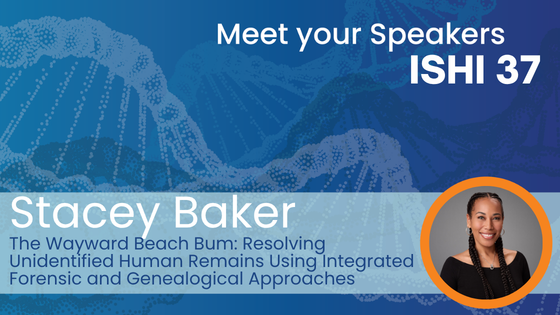
Stacey Baker, MFS, ABC-MB, of the Palm Beach County Sheriff’s Office, will present the case at ISHI 2026 in a talk called “The Wayward Beach Bum: Resolving Unidentified Human Remains Using Integrated Forensic and Genealogical Approaches.”
The tree build wasn’t the hard part. One lead’s own social media activity turned out to be the detail that moved the case forward, and Baker isn’t saying more than that before October. Below, she talks about what separated this case from the ones with an easy answer, and what happens in the jurisdictional handoff after a name finally attaches to a file.
What first drew you to this case, question, or problem?
The Palm Beach County Sherriff’s Office brought IGG in-house in 2025 so we were going back through cases that we thought would benefit from FIGG.
What's the single most important idea you want people to walk away with?
Think outside the box. What may seem obvious may not always be. Do not forget about cases that may not be solvable today. Eventually they may have the potential as new techniques come online.
What are common misconceptions this talk addresses?
Even if there is a rather easy tree build for IGG, it doesn’t mean that the subsequent investigation will be straightforward.
What's the most interesting or unexpected thing you found doing this work?
This answer would give away the story 😊
Who would benefit most from hearing this talk?
Investigators, crime analysts, FIGG practitioners
What's one thing from this talk people can actually use once they're back at work, whether that's a technique, a case example, or a new way of thinking about the evidence?
When you find the who, the case is only beginning. Multi-jurisdictional communication is key when working near bordering agencies.
What are you most looking forward to at ISHI this year, besides your own session?
I always love hearing about how unconventional methods can solve cases. The field is ever evolving so new technology plays a big role in how we can advance as a community.
What's your best advice for someone attending ISHI for the first time?
Pace yourself. There is a lot of information to absorb and the days are long.
What do you enjoy doing when you're away from the office/lab?
Travel, watch sports, play tennis, run