
Mass fatality incidents (MFIs) present some of the most complex human identification challenges forensic scientists will face. Responders may need to manage large numbers of unidentified human remains, personal effects, family reference samples, DNA profiles, and potential biological relationships, all while families anxiously await answers.
SNA International (SNA) brings experience from major mass fatality and disaster victim identification efforts, including 9/11, Hurricane Katrina, and multiple wildfire responses. Those experiences have shown us that DNA testing is only one part of a much larger identification effort. As the number of victims, samples, family members, testing locations, and organizations increases, so does the challenge of coordinating the information needed to support an identification.
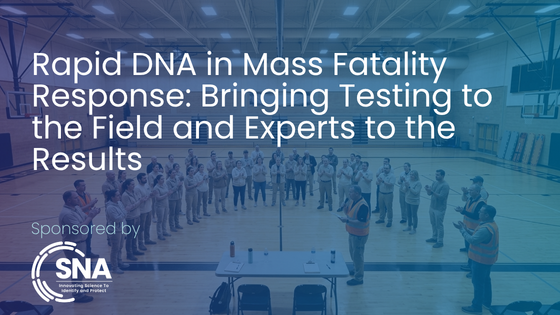
Bringing DNA Testing to the Incident
Rapid DNA offers an important opportunity to change how some of this work is performed.
Rapid DNA instruments can be deployed closer to an incident, reducing the need to transport every sample to a traditional forensic laboratory before DNA testing can begin. Multiple instruments can operate simultaneously, increasing testing capacity and potentially making DNA results available much sooner.
This is particularly valuable when an incident involves many victims, covers a wide geographic area, or limits access to laboratory facilities. But field deployment creates a new challenge.
Imagine 5, 10, or more Rapid DNA instruments operating at one or several locations. Multiple operators may be processing samples from unidentified human remains, personal effects, or family members. Each sample produces information that must be associated with its DNA result and its role in the identification effort. Some results may be straightforward. Others may fail, be incomplete, or require review by an experienced DNA analyst.
Rapid DNA can greatly increase how quickly DNA data is generated in the field. The challenge is coordinating that information as quickly and effectively as the instruments produce it.
Connecting the Field to DNA Experts
There is another challenge during an MFI response: DNA scientists needed to support an MFI may not be at the incident. Responders may be working amid dangerous conditions or disrupted infrastructure. Large responses can also continue for weeks or months, making it difficult to deploy and sustain every expert needed on-site.
People collecting samples and operating Rapid DNA instruments do not necessarily need to be experienced DNA analysts. But unusual or complex results must reach scientists who can evaluate them, even if those scientists are hundreds or thousands of miles away.
Technology connects field operations with remote DNA analysts. Routine results can move through established processes, while results requiring additional attention can be referred off-site, drawings a broader pool of scientific expertise without adding to deployment demands.
Kinship Adds Another Level of Complexity
MFI can become more challenging when direct reference samples are unavailable or questioned, and identification depends on family reference samples. Kinship analysis is sometimes described as building a pedigree, but a pedigree only represents proposed biological relationships. Scientific evaluation behind it is considerably more complex.
Analysts may need to consider various possible biological relationships, multiple family members, population allele frequencies, mutation rates, linked loci, incomplete family structures, and competing relationship hypotheses. The strength of the genetic evidence must then be evaluated statistically, including through likelihood ratios.
At scale, kinship requires more than drawing family trees. Relationships and DNA data must be organized, appropriate calculations performed, and information made available to scientists evaluating potential identifications.
Coordinating the Identification Effort
A devastating wildfire illustrates how this model can work in practice. The fire claimed more than 100 lives, leaving severely burned and highly compromised human remains. Rapid DNA instruments were brought to the response site. while DNA analysts approximately 5,000 miles away performed complex kinship analyses to evaluate family relationships and support identifications.
Those scientists did not need to be physically present at the disaster site. Connecting field-based DNA testing with remote support brought specialized expertise to the identification effort without adding to demands at the disaster site.
Deploying instruments is only the beginning. A response also needs to coordinate instruments and testing locations, track samples and identify results, organize information about unidentified remains and family references, support kinship analysis, and identify results requiring scientific review. Most importantly, the people generating DNA results in the field need to be connected with the DNA professionals who can support them.
Experience Informing DNAConnect
Challenges encountered in MFIs and disaster victim identification efforts have helped inform DNAConnect, SNA’s software platform for managing Rapid DNA programs and human identification workflows.
DNAConnect’s Missing Persons and Kinship features bring together different parts of the identification process. The platform can support multiple Rapid DNA instruments from multiple vendors, multiple testing locations, organize information associated with unidentified human remains and reference samples, associate DNA results with related information, support kinship analysis, and connect field personnel with DNA analysts providing remote scientific support.
DNAConnect manages response information, routes results requiring scientific expertise, organizes pedigrees and DNA profiles, and performs complex calculations. But scientific evaluation remains essential.
Preparing for the Next Mass Fatality Incident
When an MFI occurs, forensic science can play a critical role in providing answers to families and helping communities recover. The forensic science community is a valuable resource for an MFI and should be ready to bring the best available science, technology, and expertise to that effort. Past mass fatality responses have shown what is possible when DNA testing and scientific expertise are brought together effectively. Rapid DNA can move testing closer to an incident, while technology can make it possible to draw on DNA expertise far beyond the response site.
The challenge is being prepared to do this at scale. A major incident may require multiple Rapid DNA instruments, numerous testing locations, hundreds or thousands of samples, family reference collection, complex kinship analysis, and DNA analysts working both on-site and remotely. Those activities and the information they generate must be coordinated as part of the same identification effort.
We may not know where the next incident will occur, how many people will be affected, or what conditions responders will face. What we can do is prepare the systems, processes, and connections that will enable the forensic science community to respond effectively when it does.
Rapid DNA gives us the ability to generate results closer to where they are needed. Being prepared also means being able to manage those results, connect them to the information needed for identification, and bring the right scientific expertise to the effort, wherever that expertise may be.