
At ISHI, we believe the future of forensic DNA is shaped not just by today’s experts, but by the students who are stepping into the field with fresh ideas and fearless curiosity. That’s why each year we invite Student Ambassadors to share their research, their stories, and their vision for what comes next.
In this blog series, we’re giving you a first look at the posters these ambassadors will be presenting at ISHI 2025. Each spotlight is a chance to see the science through their eyes — the challenges they’ve tackled, the breakthroughs that surprised them, and the impact they hope to make.
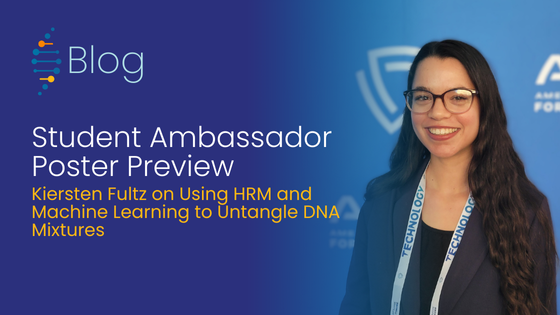
First up is Kiersten Fultz, a graduate student at Virginia Commonwealth University. Her research uses high-resolution melt (HRM) analysis and machine learning to give analysts a head start when working with DNA mixtures. What began as a steep learning curve in RStudio has turned into a project that could help labs save time and make smarter decisions earlier in the workflow.
Tell us the story of your research. What sparked the question, and what have you discovered so far?
Even though I am not the first student to work on the “HRM project,” I felt both honored as well as intimidated to take over a project with such a potentially informative impact. The question of how to provide additional information about biological samples before an STR profile is produced led to the assessment of high resolution melt (HRM) curve data, collected at the quantitation stage of the DNA workflow, used with a statistical prediction modeling algorithm to make predictions regarding the contributor status of each sample. Having an idea of whether a sample collected at a crime scene is from a single source or contains DNA from multiple contributors (mixture), allows for proactive decisions to be made before amplification and capillary electrophoresis are completed. These decisions can include combining two samples collected from the same source that have the same single source genotype prediction or increasing the DNA input for amplification of a sample predicted as a mixture to bring all minor contributors above threshold for easier interpretation. My portion of the project involved performing final optimization tests on the prediction modeling algorithms to determine the best method to use when assessing the prediction accuracy, reproducibility, genotype, and number of contributors in various sample types. The final recommended assay uses a 2-category labeling system for prediction modeling (single source or mixture) and assesses the outputs of three different machine learning models to make final predictions for each unknown sample.
What drew you to this specific topic—and why does it matter to you personally or professionally?
As someone who aspires to become a forensic DNA analyst, I believe it is important not only to just learn the universal DNA processing workflow and laboratory protocols, but to think of the future and how this process can be continuously improved as well. During my graduate studies, I have learned about trace DNA and how STR profiles are now able to be obtained from these samples. The potential to gain more information from samples containing lower amounts of DNA helped me to appreciate the purpose of my project and made me feel as though I were contributing to the expansion of possibilities in the forensic DNA community.
What’s one method or part of your research process that you found unexpectedly challenging or exciting?
The most challenging part of my research was learning how to use Rstudio, which is the coding software in which the statistical prediction modeling algorithms were programmed. Learning which lines of code needed to be updated, how to upload datasets into the program, and troubleshooting errors provided a steep learning curve for me when I first started my research. After receiving training from my peers and taking several classes on coding and biostatistics, I began to slowly understand how to use the program and run the codes. The most challenging aspect of the project became one of the more exciting parts as I began to get my own results and understand the bigger picture of my research. This stage of my research led me to believe in myself more and allow myself to make mistakes, ask more questions, and to take each day one at a time.
Was there a moment during your research where something clicked—or didn’t go as expected? How did you adapt?
Things began to really click for me when I started processing more DNA samples and adding their HRM data to the existing datasets. Working from the beginning of the workflow by extracting DNA from buccal swabs, to the end, which involved assessing the prediction outputs produced by the algorithm, put the methodology and how the assay would be used in the field into perspective.
What real-world problem do you hope your research helps to solve, and who do you hope it impacts most?
I hope this research can one day provide forensic DNA analysts with more information about the samples they process before DNA amplification and capillary electrophoresis, to allow for more proactive decisions to be made regarding treatment of the samples before further processing. Using this screening tool can potentially save analysts time and expenses that would normally be spent reprocessing convoluted sample profiles.
If someone only remembers one thing from your poster, what do you hope it is? Looking ahead, what’s the next question you’re itching to explore?
I hope that anyone who views my poster remembers that small changes in research can make a big difference. Research doesn’t always have to solve problems, but can be a steppingstone in providing more information about a particular technique or process in the experiment. Looking ahead, I think it would be interesting to explore newer machine learning models that could potentially be used in the same manner as in the integrated Quantifiler Trio™ HRM assay prediction modeling algorithm and how results would vary depending on these different models.