
Every ISHI Student Ambassador brings a unique perspective on the science shaping the future of forensic DNA. Through this series, we’re highlighting their research, the questions driving their work, and the impact they hope to make.
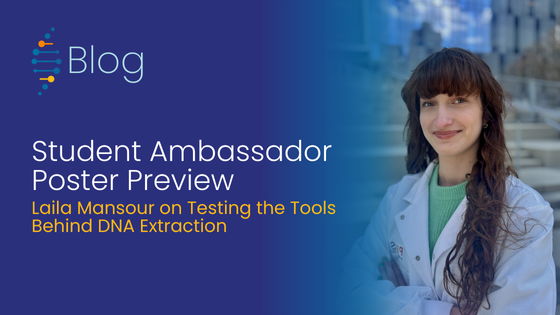
Meet Laila Mansour, whose project takes a closer look at something many of us take for granted in the lab: the reliability of our instruments. By comparing DNA extraction results from two commonly used systems—the QIACube and the EZ1—Laila’s research underscores how even small differences in performance can have big implications for casework.
Her journey through unexpected troubleshooting, from miscalibrated pipette arms to surprising yield discrepancies, is a reminder that innovation often begins by asking simple questions: Is this tool giving us the best results it can? For Laila, the answer carries weight not just for her own lab, but for the broader forensic community.
Tell us the story of your research. What sparked the question, and what have you discovered so far?
We noticed that our lab had two DNA extraction instruments, the QIACube and EZ1, but the QIACube was primarily used, especially in coursework. We were curious if there was any significant difference between the extraction capabilities of the two instruments. In initial runs, we noticed a significantly decreased quantity of extracted DNA from the EZ1, which was cause for concern considering the EZ1 is the extraction instrument utilized by the NYC OCME.
We hypothesized that this was due to a decline in instrumental function, so for this project we tested the QIACube against both the EZ1 in our lab and the EZ1 at the OCME. As suspected, the low yields for our EZ1 seemed to be due to decline in instrument function, as the EZ1 at the OCME yielded quantities statistically similar to that of the QIACube.
What drew you to this specific topic—and why does it matter to you personally or professionally?
The quality and quantity of extracted DNA from biological evidence influence the success rates for DNA analysis in criminal investigations. Therefore, evaluating DNA extraction methods is essential for achieving optimal DNA recovery. More generally, validating protocols and instrumentation is a vital part of forensic methodology. Ensuring labs are utilizing the most efficient and accurate instrumentation is crucial to ensuring justice. I valued the opportunity to delve deeper into thinking about and even questioning the tools we use in the lab.
What’s one method or part of your research process that you found unexpectedly challenging or exciting?
There was definitely a lot of unexpected troubleshooting involved for the instruments. There was one period that the QIACube was not functioning properly, and it was all because the calibration of the arm used to pick up the pipette tips was slightly off. Experiences like that definitely solidified the importance of every detail.
Was there a moment during your research where something clicked—or didn’t go as expected? How did you adapt?
The project overall definitely emphasized the necessity of funding and equipment for forensic laboratories. Even just a slight, fixable malfunction in one of our instruments caused some delays in our project and other projects in the lab.
What real-world problem do you hope your research helps to solve, and who do you hope it impacts most?
The extraction and analysis of DNA is time-consuming and often challenging, especially as samples often appear in minimal quantities and can be degraded/contaminated with PCR inhibiting substances. These issues, combined with the growing volume of cases, can lead to substantial backlogs in forensic laboratories. Researching instruments with more efficient automation and increased sample throughput could be a potential solution to solving these issues.
If someone only remembers one thing from your poster, what do you hope it is?
The major takeaway I want people to have from my poster is to question and test everything. Questioning protocols and instruments not only breeds innovation but also ensures that we are maximizing the outcomes of investigations.
Looking ahead, what’s the next question you’re itching to explore?
I’m currently working on a forensic botany project in which we’re working on developing genetic profiles for different plants for species identification. It has been interesting to bring the knowledge from this project to a different application, especially an application that could have a significant impact in the forensic DNA world.