
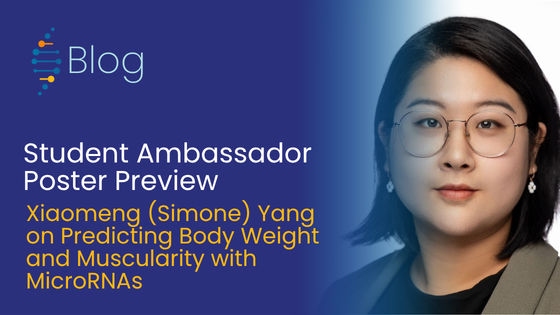
Simone Yang’s data told her saliva samples were the weaker ones: lower sequencing quality, fewer usable reads than blood. Then the validation results came back, and saliva held the strongest, most consistent markers in the entire study.
She’s investigating whether microRNAs, small molecules that shift with a person’s metabolism and physical activity, can predict body composition traits like weight and muscularity from blood and saliva samples. It’s a real gap in forensic DNA phenotyping: eye and hair color have solid genetic predictors, but body composition has resisted a reliable model because it’s shaped by environment as much as genetics.
Read on for what a good day in the lab looks like, why that saliva result mattered more than it first seemed, and what she hopes people remember when they walk away from her poster.
What's the story behind your research — what made you curious about this specific question in the first place?
Forensic DNA phenotyping can predict traits such as eye, hair, and skin color, but body composition is much more difficult to estimate because it is influenced by genetics, the environment, and a person’s lifestyle. That made me curious about whether microRNAs, which respond to physiological changes and remain relatively stable in forensic samples, could provide another way to predict traits such as body weight, body fat, and muscularity.
Describe your research to someone who hasn't worked in your specific area.
My research investigates whether small molecules called microRNAs in dried blood and saliva can provide clues about a person’s body composition. I use sequencing to discover promising microRNAs, validate them using quantitative PCR, and ultimately hope to combine multiple markers into statistical models for forensic prediction.
What's the moment in your research that surprised you most — a result you didn't expect, a method that didn't behave, or a finding that made you rethink everything?
I was most surprised that saliva produced lower sequencing data quality and fewer usable reads than blood, yet the strongest and most consistent body-composition-associated markers were discovered in saliva. That showed me that we couldn’t predict the results based on the initial data alone. We had to validate the markers to understand their potential.
What does a good day in your research actually look like — and what does a hard one look like?
A good day is when the experiment is successful, the controls behave as expected, and the results reveal a clear pattern that moves the project forward. A difficult day is when a marker behaves differently during validation than it did during sequencing, or I have to troubleshoot an entire experiment without knowing whether the problem came from the sample, reagent, instrument, or method.
What impact do you hope your research will have on the field?
I hope this research can expand forensic DNA phenotyping by showing the potential of microRNAs for predicting complex physical characteristics. In the long term, a validated microRNA panel could provide investigators with additional information about an unknown individual when conventional STR profiling does not produce a match.
If someone walks away from your poster remembering one thing, what do you want it to be?
I want them to remember that microRNA analysis could be used to obtain additional identity-related information from existing biological evidence.