
Sponsored by QIAGEN
Laying the Groundwork: Forensics Before DNA
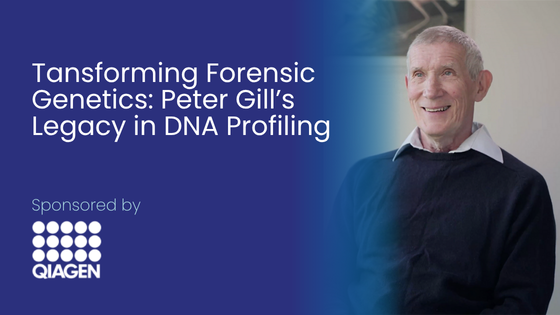
Peter Gill, now Professor of Forensic Genetics at Oslo University Hospital, began his career in 1982 at the United Kingdom’s Forensic Science Service (FSS). At that time, DNA profiling did not exist. Investigators relied on protein polymorphisms, which were unstable, offered low discrimination and degraded easily. Gill, with a background in population genetics from Nottingham University, recognized the potential of DNA – even though DNA profiling in the early years was labor-intensive and required large amounts of sample. His resolve was strengthened by miscarriages of justice, such as the Birmingham Six, which underscored the need for more robust, quality-assured forensic science.
A Pivotal Partnership: Collaborating with Alec Jeffreys
In 1985, Alec Jeffreys published a landmark paper introducing DNA fingerprinting, and Gill saw the technology’s potential for forensic application. He reached out to Jeffreys, and together they began testing whether the technique could work with challenging forensic samples.
At the time, laboratories struggled to implement the technology because it required specialized facilities for handling radioactive materials and darkrooms for processing X-ray plates. They had to hand-make probes, reagents and even equipment in-house. There were no biotech suppliers, and setting up the necessary infrastructure was a formidable task. Yet with support from the Aldermaston Laboratory department head and UK Home Office – responsible for domestic security, crime and immigration policies in the United Kingdom – they built a functional lab to test DNA extraction from years-old forensic samples.
Cracking the Sperm Barrier: Inventing Differential Extraction
Gill’s early role involved developing extraction methods for old semen stains, blood and hair roots. One major hurdle was sperm samples that failed to release DNA after the standard extraction method. Literature review revealed the issue: a sulfur-rich protein coat compacting the DNA. The solution came in the form of Cleland’s reagent (DTT), a chemical that breaks disulfide bonds. This breakthrough led to the development of a two-stage differential extraction method:
- Detergent lysis and centrifugation to separate non-sperm cells, like female epithelial cells
- DTT and Sodium dodecyl sulfate (detergent) treatment to lyse sperm and extract male DNA
This method successfully isolated sperm DNA even from mixed samples and remains a staple of forensic biology over four decades later.
The Breakthrough: Proving DNA Could Work
By mid-1985, Gill had developed reliable DNA extraction methods. The results were definitive: blood, hair and differentially extracted semen samples all produced unique DNA profiles. This feat culminated in a Nature paper and propelled their work into global prominence.
The Narborough Murders: The First DNA Case
The technique’s real-world impact was proven in 1987 during the Narborough double rape-murder investigation. Suspect Richard Buckland confessed to one crime but denied the other. DNA profiling showed both crimes were committed by the same individual, and crucially, Buckland was excluded – marking the first DNA-based exoneration. To find the real perpetrator, investigators conducted the world’s first mass DNA screening. Eventually, Colin Pitchfork was identified after trying to evade testing by sending a proxy. This case showed DNA’s power to both convict and exonerate, and laid the groundwork for the UK’s National DNA Database.
From Fingerprints to STRs
Initially, DNA profiling used multi-locus probes, but due to poor reproducibility, forensic labs transitioned to single-locus probes, improving reliability and making databases feasible. The development of PCR and fluorescent labeling also accelerated the shift to STR profiling. While the US focused on high molecular weight markers, the UK concentrated on STRs, which later became the global standard.
Landmark Investigations: Romanovs and Waco
Gill’s expertise was sought in high-profile cases. In 1993, his team analyzed the Romanov family remains, using STRs to determine family group and mitochondrial DNA to confirm identities with a maternal match to Prince Philip, Duke of Edinburgh. That same year, Gill collaborated with US authorities after the Waco siege, applying a quadruplex STR system to identify severely burned victims. Both cases highlighted the robustness of STRs and accelerated their worldwide adoption.
Building the UK’s National DNA Database
In 1995, as Head of Research at Aldermaston, Gill led the creation of the world’s first National DNA Database. Early quadruplex systems provided limited discrimination, so his team developed a six-locus multiplex to increase reliability. At first, multiplexes were produced in-house until biotech companies later expanded them into larger panels, eventually evolving into today’s highly discriminating over 20-locus kits.
Low Copy Number DNA: New Sensitivity, New Challenges
PCR also enabled low copy number (LCN) DNA profiling, making it possible to analyze touch DNA from just a few cells. While this increased sensitivity, it also introduced interpretation challenges such as allele dropout and drop-in. Gill’s team developed probabilistic interpretation methods and software that remain the foundation of mixture analysis today.
Looking Ahead: Recovery and Interpretation
Despite advances, differential extraction has remained virtually unchanged for four decades. Gill emphasizes that any new methods must undergo rigorous back-to-back validation and must demonstrate superior DNA recovery before adoption.
Gill identifies two ongoing challenges. First, DNA recovery varies widely across labs, as shown by the REACT Project, highlighting the need for standardized controls. Second, with DNA now detectable in dust and air, presence alone does not imply guilt. More collaboration and standardized recovery methods are essential to support activity-level interpretation.
Advice for the Next Generation
Gill’s message to scientists is clear: “Question everything.” His career shows how challenging assumptions and pursuing ideas others dismiss can lead to breakthroughs that transform justice worldwide.
Explore the Next Step in Forensic DNA Recovery
Differential extraction has stood the test of time, but new tools like EZ2 DNA Investigator Sep&Prep offer laboratories the potential to streamline workflows and maximize DNA recovery from challenging samples. By building on the principles pioneered by Peter Gill, Sep&Prep is designed to help forensic scientists obtain more reliable results with greater efficiency. Discover Sep&Prep here.