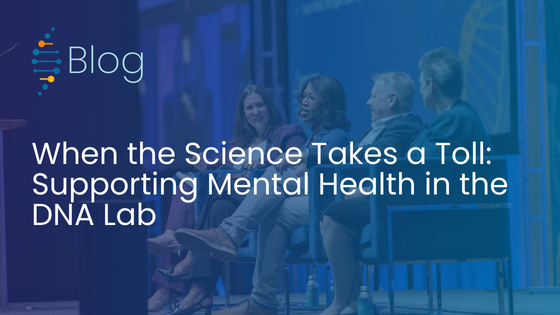
At the 36th International Symposium on Human Identification (ISHI), a room filled with forensic professionals turned their attention away from the lab bench and toward something more personal—burnout. In a field defined by precision, pressure, and impartiality, the emotional cost of doing the work has long been overlooked. This year’s panel, “Behind the Bench: Combating Burnout in Forensic DNA Laboratories,” invited attendees to recognize burnout not as a weakness, but as an urgent workplace issue demanding thoughtful, systemic solutions.
The panel brought together a compelling mix of voices:
- Jennifer Dillon, a former DNA analyst who now leads wellness and resiliency initiatives for the Michigan State Police
- Brian Hoey, director of the Missouri State Highway Patrol Crime Laboratory System
- Sharon Polakowski, a veteran analyst at the Wisconsin State Crime Lab
- Tracie Webb, a licensed psychologist working with first responders in Michigan
Together, they shared personal stories and professional insights that resonated deeply with the forensic DNA community.
The Weight of the Work
Forensic DNA analysis often carries a quiet intensity. Analysts are expected to be meticulous, impartial, and objective. But beneath the veneer of scientific rigor lies the emotional weight of dealing with violence, tragedy, and trauma—often in isolation.
“There’s a certain emotional weight to this type of work,” said Dillon. “We are expected and told to be unbiased. And a lot of times, that means separating ourselves from feelings, which has a cost. Working in a field where mistakes carry a heavy consequence has a weight to it as well.” This cost often manifests as emotional exhaustion, detachment, or cynicism. When repeated over years, it leads to burnout.
Polakowski, who has worked in the field for more than three decades, pointed to a key source of long-term stress: the rapid evolution of forensic technologies. Each new system—from STR to probabilistic genotyping—requires time to master and must be defensible in court. “Forensic biology just doesn’t stand still,” she said. “That’s difficult.”
Compounding the stress is the stark reality that many decisions affecting labs—budgets, staffing, turnaround time expectations—are shaped by external political or legislative forces. “Those are far outside of our control as analysts and often as management, because at least in my state, all that’s controlled by the legislature,” she said.
The Hidden Stress of Leadership
While benchwork carries its own pressure, stepping into management can be just as challenging—if not more. Brian Hoey offered a candid account of his transition into a leadership role, a move that left him feeling overwhelmed and underprepared. “We go to school to be biologists. And all of a sudden someone points a finger and says, ‘you’re promoted to supervisor right now.’ You’re the person in charge of making sure your people don’t suffer from the burnout and the stress,” he said. “They don’t teach you human development. They don’t teach you how to be a supervisor.”
Hoey recalled how the shift to management meant suddenly becoming the person people came to with problems—without any training in how to help. “The most stressed I’ve ever been on the job was the transition between bench and supervisor,” he admitted. It affected not just his work life, but his home life. “I would not leave the job at home or at work. That was a wakeup call for me.” His story underscored a recurring theme: that burnout is not only about heavy caseloads or court deadlines. It’s also about lack of preparation, lack of support, and the emotional burden of leading others through high-stakes, high-stress work.
Recognizing the Signs
Clinical psychologist Tracie Webb provided a framework for understanding burnout as a specific, diagnosable condition that includes emotional exhaustion, depersonalization, and a diminished sense of personal achievement.
She encouraged attendees to conduct regular “body scans”—a self-check for signs of mental, emotional, and even spiritual depletion. “Am I physically worn out? Am I emotionally worn out? Am I spiritually worn out?” she said. “If you figure out where the deficit is you can figure out the solution.”
One sign that often goes unnoticed? A loss of humor. Webb shared a story about a colleague who gently pointed out that she hadn’t laughed in two weeks—a small but powerful observation that prompted her to re-evaluate her own stress level.
For forensic scientists, that erosion of joy or connection can be subtle, especially when masked by the expectation of professionalism. But, as Webb noted, “If you’ve asked yourself the question ‘am I on the verge of burning out or am I already burned out?’, if you’ve got enough awareness to say, huh? Is this happening to me? The answer is probably yes.”
Building Boundaries, One 'No Day' at a Time
Solutions to burnout, the panel agreed, must be both personal and organizational. Webb recommended giving oneself permission to disconnect. She introduced the idea of a “no day”—a scheduled day, even once a month, when the default answer is “no” to anything non-essential. “Unless something’s on fire, you’re bleeding, choking and or drowning,” she joked, “the answer is no.”
Polakowski spoke about taking work email off her personal phone, refusing to check Teams on vacation, and creating space to socialize with people outside the forensic world. “I love what I do, but it’s hard,” she said. “It is very stressful, though, and so having other outlets, having hobbies, having other things that I do for me helps.”
She also emphasized the need for peer support beyond the lab, especially in toxic or punitive work environments. “I think at the worst point, I had considered switching sections to become a drug chemist instead, but I didn’t, and things have gotten a lot better,” she shared. But she found leaders who helped her stay. “Now I have the freedom to say, ‘I need a break’—and [my supervisor says] ‘Let’s give you the break you need. How can I help?’ So that is a huge thing to hear from a supervisor.”
What Leadership Can Do (And What They Can’t)
The panel was clear: preventing burnout isn’t just about individual resilience. It requires a culture of psychological safety—something that leaders must actively create. “Just saying, ‘My door is always open’ isn’t enough,” said Dillon. If the person inside the room isn’t safe, no one’s walking through that door.
Webb emphasized the power of asking the right questions. “Try, ‘Tell me your understanding of the situation,’” she advised. “It’s a non-judgmental question, and it allows people to state what’s going on for them. I could be seeing what I’m deeming an attitude problem or a or personality problem and but it’s actually a training problem, right?”
For Hoey, the lesson was about role clarity and locus of control. Too often, he said, staff become frustrated by decisions beyond their influence. “I’m saying this from a leadership coaching perspective – Be accountable for yourself. The survivors of crime require our attention on the bench, not of what is going on around us. We need to have the appropriate locus of control on what we can influence, on what we can change. And that is our casework.”
Reclaiming Meaning and Satisfaction
One of the lesser-known contributors to burnout in forensic labs is a lack of closure. Analysts rarely know what happens after a report is submitted or a suspect is identified. For Dillon, who once worked on a sexual assault team, this disconnection from outcomes led to what she described as “compassion fatigue.” The result was a kind of emotional detachment from the very cases that had once inspired her.
Reconnecting with that sense of purpose—whether through mentorship, professional development, or simply taking time to reflect—was a key takeaway. “You chose to go into this field. How cool is that? That you get to do something really awesome that the average person doesn’t get to do,” said Webb. “Even that is empowering. Lean into that.”
A Shared Responsibility
Burnout is not a personal failing. It is a systemic issue that touches every corner of the forensic community—from the analyst struggling with trauma exposure to the supervisor navigating policy demands. It won’t be solved with a yoga class or a motivational poster.
What this panel made clear is that well-being in forensic science must be viewed as a collective commitment. As Dillon reminded attendees in her closing remarks: “We all have a role to play. Whether you are new to the field or looking at retirement, whether you are an informal leader or leading from the top, there are things you can do to take care of yourself, model self-care and wellness, and take care of other people.”
Rather than offering quick fixes, the panel called for an ongoing conversation—one grounded in honesty, empathy, and structural support. In a profession where the stakes are high and the emotional toll often hidden, that kind of dialogue may be one of the most important tools labs have.