Transfer DNA: An updated and Unbiased Term for Touch/Trace DNA
Authored by: Angela Williamson, Abigail Bathrick, Mike Cariola Forensic scientists have long recognized the phenomenon and probative value of DNA transferred to people or objects through direct or indirect contact1. Various terms have been utilized by the forensic community over the past decades to include Touch, Trace, and Wearer DNA. However, the need for standardized […]
Difficult Does Not Mean Impossible
Difficult evidence will always require forensic expertise. The process surrounding it does not have to be equally difficult. Better methods can give challenging samples another opportunity to provide information, accessible collection tools can help clients use those methods more readily, and better laboratory systems can protect analysts’ time for the decisions that require their judgment. […]
LOAD. START. WALK AWAY. Experience What’s Next in Forensic DNA Sample Prep at ISHI 2026
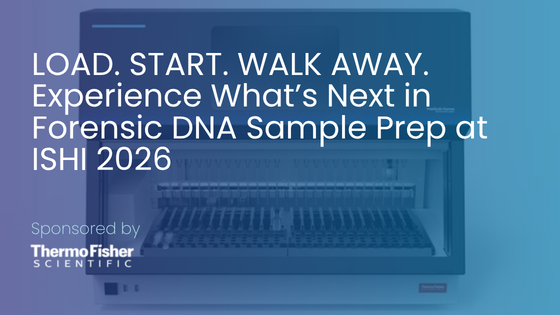
There’s automated forensic DNA extraction. And then there’s true walk-away automation. At ISHI 2026, Thermo Fisher Scientific will unveil the new Applied Biosystems™ PrepStudio™ Express DNA Extraction System—a benchtop system designed to bring true walk-away automation to forensic DNA sample preparation. Designed to fully automate lysis and DNA purification for forensic casework and sexual assault […]
Rapid DNA in Mass Fatality Response: Bringing Testing to the Field and Experts to the Results
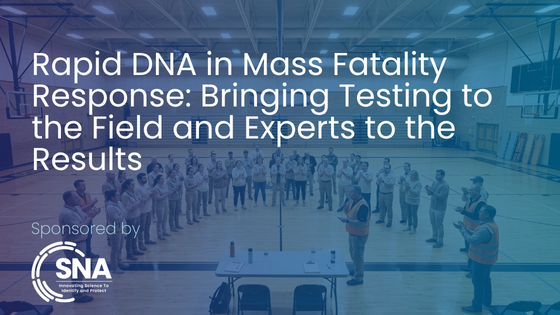
Mass fatality incidents (MFIs) present some of the most complex human identification challenges forensic scientists will face. Responders may need to manage large numbers of unidentified human remains, personal effects, family reference samples, DNA profiles, and potential biological relationships, all while families anxiously await answers. SNA International (SNA) brings experience from major mass fatality and […]
Protecting Forensic DNA Workflows: How High-Purity Consumables and Automation Support Reproducible Results
In forensic DNA analysis, confidence begins long before amplification and interpretation. It starts with the integrity of every sample, every tube, and every pipette tip that touches precious evidence. Because even trace contamination can compromise results, Eppendorf has designed tools not only for precision, but also for contamination control, documentation, and workflow consistency. Why Contamination […]
This Week in Forensic Science
No one has hours to scour the papers to keep up with the latest news, so we’ve curated the top news stories in the field of Forensic Science for this week. Here’s what you need to know to get out the door! Marshall University Forensic Science Center Receives $2.5 Million to Expand DNA Testing (Marshall.edu – […]
STR Nomenclature: Building a Common Language for Forensic Genomics
As next-generation sequencing (NGS) becomes more commonplace in forensic genetics, one of the critical questions facing NGS-equipped laboratories is: how can scientists consistently interpret, share and compare short tandem repeats (STR) sequencing data? At the center of this challenge is STR nomenclature – the system used to describe STR alleles. Insights from experts such as […]
Forensic MPS. Redefined.
Massively parallel sequencing (MPS) has long promised to transform forensic DNA analysis. The ability to interrogate more loci, generate richer allele data, and multiplex dozens of samples in a single run represents a compelling leap forward from capillary electrophoresis (CE). Yet adoption in routine casework has remained limited—held back by complex, multi-step library preparation workflows […]
This Week in Forensic Science
No one has hours to scour the papers to keep up with the latest news, so we’ve curated the top news stories in the field of Forensic Science for this week. Here’s what you need to know to get out the door! FBI Laboratory Eliminates DNA-Processing Backlog (FBI.gov – 9/18/2026) A team of laboratory, data-management, and […]