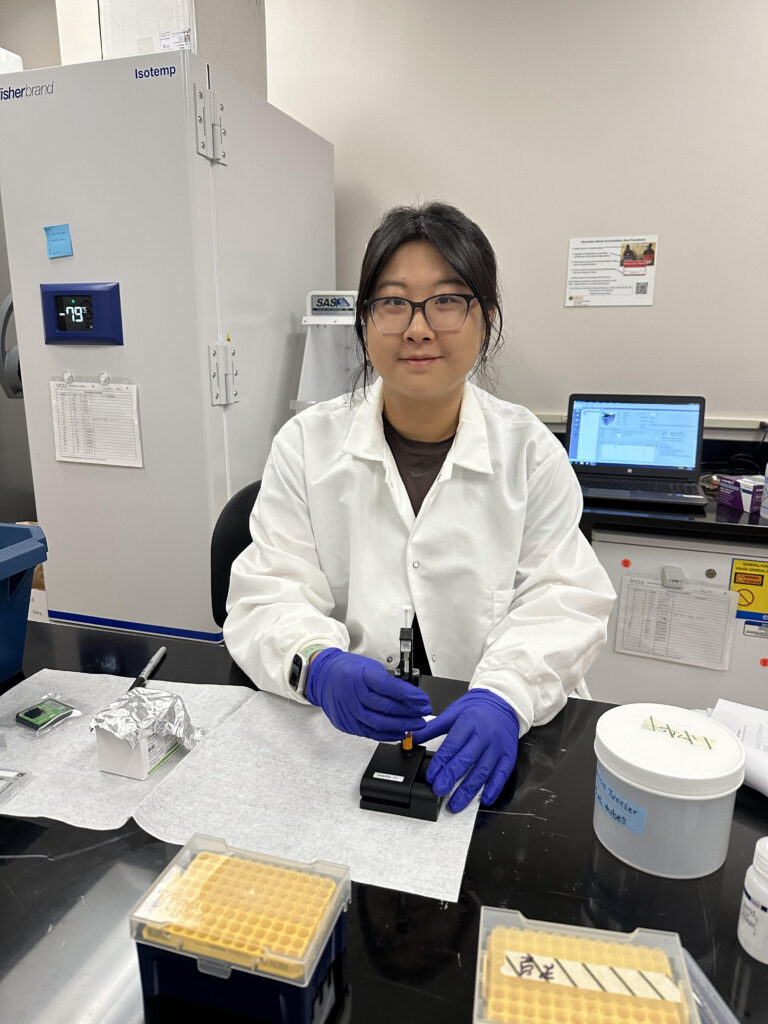
Dried whole blood. A saliva swab. From either sample, Simone Yang is working to estimate not just who was there, but their weight and build.
Xiaomeng (Simone) Yang is one of five ISHI 37 Student Ambassadors attending this year’s symposium in Providence, Rhode Island. The Student Ambassador Program gives emerging forensic scientists a place at the table before most of the field knows their names. Over the coming weeks, we’ll introduce all five.
A fourth-year PhD candidate at Virginia Commonwealth University, Simone works under Dr. Sarah Seashols-Williams and Dr. Tracey Dawson Green to develop microRNA-based methods for estimating weight and muscularity from forensic samples, including dried whole blood and saliva. Her research builds on earlier work at Boston University, where she used microRNAs to identify forensically relevant body fluids. At ISHI 37, she will present a poster on her findings.
Below, Simone answers seven questions about her path into forensic science, what the final stretch of a PhD actually feels like, and what she wants the forensic community to know about the students coming up behind her.

What's your forensic science origin story — was it a TV show, a real case, or something you never saw coming?
My interest in forensic science came from a real case in Japan where a husband preserved the house where his wife was murdered, hoping the case would one day be solved. Nearly 20 years later, advances in DNA technology allowed investigators to analyze preserved evidence from the scene and identify the perpetrator. That story showed me how powerful forensic science can be, especially as technology continues to evolve. It inspired me because cases that seem unsolvable today may still find justice in the future.
What's the thing in your program that nobody warns you about — and that you now feel obligated to tell every incoming student?
One thing nobody really warns you about is how often research doesn’t go according to plan—and that’s completely normal. Experiments fail, instruments break, samples get delayed, and sometimes months of work lead you to rethink your entire approach. I’d tell every incoming student that resilience and adaptability are just as important as technical skills, because learning how to troubleshoot and pivot is a huge part of becoming a scientist.
What stage of your journey are you at right now — and what does that actually feel like day to day?
I’m currently in the fourth year of my PhD, so I’m much closer to the end of the journey than the beginning. It’s rewarding to look back and see how much I’ve grown—from being a new student who relied heavily on guidance from senior lab members to now helping manage the lab and mentoring newer students myself. Day to day, I still face challenges and unexpected obstacles, but I’ve become much more confident in navigating them. What keeps me motivated is that I’m still learning something every day, whether it’s new scientific knowledge, hands-on experience, or friendships along the way.
What's the biggest misconception people have about what forensic scientists actually do all day?
One of the biggest misconceptions is that all forensic scientists spend their days at crime scenes or working directly with dead bodies—my parents used to describe the field exactly that way. From my experience as a student studying forensic molecular biology, much of the work is centered around laboratory research, analyzing biological evidence, developing methods, and generating data that can support investigations. TV shows and true crime media often focus on the dramatic side of forensics, but there are also many scientists working behind the scenes whose research and laboratory work help advance the field and support the justice system.
What's the one conversation, session, or experience you'd consider a win when you leave Providence?
I’d consider it a win if I have meaningful conversations with professionals about my research, especially during the poster session. I’m excited to hear different perspectives, constructive feedback, and how others in the field interpret my studies. If I leave Providence with a new research idea to explore, a potential collaboration, or advice that contributes to my current project, I’d consider that a very successful experience.
What's the best part of lab life that nobody talks about — and the part you're still making peace with?
The best part of lab life that people don’t talk about enough is the community. Beyond the research itself, you build important friendships with lab mates, collaborators, and faculty mentors, and you often gain life lessons and support systems that extend far beyond science. The part I’m still learning to navigate is work-life balance, because research can easily spill into late nights and weekends, especially near deadlines. I’ve realized that better planning and time management are essential—not just for productivity, but for maintaining a healthier routine and making time for family and friends.
What do you want the forensic science community to know about the students walking into this field right now?
I want the forensic science community to know that the students entering this field today are bringing fresh ideas, strong technical training, and a genuine drive to innovate. We’ve grown up alongside rapidly advancing technologies—from molecular techniques to computational tools—and we’re excited to explore how they can strengthen and modernize traditional forensic practices. At the same time, we deeply respect the responsibility that comes with this field and are willing to put in the hard work needed to turn new possibilities into reliable forensic applications.