
Are you a passionate student pursuing a degree in forensic science, eager to dive into the world of cutting-edge research and groundbreaking advancements? Look no further! The ISHI Student Ambassador Program is your exclusive gateway to unparalleled opportunities at the International Symposium on Human Identification (ISHI) conference. The application window opens on February 2, 2026.
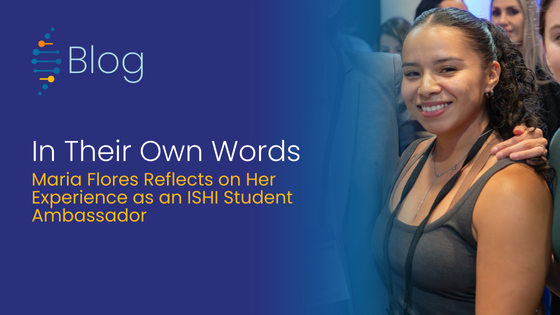
For Maria, the spark that led to a career in forensic genomics started with a strawberry and a high school DNA extraction. Fast forward to ISHI 2025, and she’s now at the forefront of age prediction research using DNA methylation—bringing a data-driven, equity-focused lens to one of the field’s fastest-growing areas.
As a Student Ambassador, Maria brought both technical insight and personal purpose to the conference. In this Q&A, she reflects on how her path has come full circle, what it means to be a first-generation scientist in the forensic space, and how she hopes to bridge research, policy, and real-world impact in the next phase of her career.
You’ve described a moment in high school when extracting DNA from a strawberry set you on this path. As someone now developing cutting-edge age prediction models, how did presenting your research at ISHI feel as a full-circle moment in your journey?
Having first attended ISHI in 2019 in Palm Springs, returning this year to West Palm Beach felt like a full-circle moment in my academic journey. In 2019, I presented a poster with my lab mates on the accuracy of DNA mixtures interpretation across human groups with varying levels of genetic diversity. This year, I had the opportunity to present my dissertation research on developing an age estimation model based on DNA methylation patterns. Reflecting on these experiences, I am reminded of how my fascination with DNA began. From a simple strawberry DNA extraction experiment to now contributing to the advancement of forensic genomics through multiple analytical approaches.
You’ve spoken about the responsibility of ensuring forensic tools are equitable and inclusive. Did any conversations or presentations at ISHI challenge or deepen your thinking on how forensic science can better serve diverse populations?
The presentation given by exoneree Jeffrey Deskovic served as a powerful reminder of the critical importance of equity and rigor in forensic science. Mr. Deskovic’s wrongful conviction, resulting from insufficient diligence and oversight within the legal system, underscores the potential consequences when forensic evidence is not analyzed with the utmost care. The lack of careful consideration in this case leads me to further reflect on the risks that arise in interpretation under challenging conditions like degraded samples or low-template inputs where error increases. This highlights the need for the forensic science community to strengthen its commitment to accuracy, transparency, and inclusivity. Advancing the field will require not only improved scientific practices but also sustained efforts to support and mentor individuals from diverse backgrounds, ensuring that the future of forensic science reflects and effectively serves the communities it impacts.
Your non-linear methylation model addresses limitations in traditional age estimation approaches. What kind of feedback did you receive during your presentation? Were there any insights or connections that sparked ideas for future directions?
I received valuable feedback during my presentation, including the observation that a mean absolute error of approximately 3.7 years represents a strong level of performance for an age estimation model. Additionally, connecting with another student ambassador, Josefina, who is conducting age estimation research in bones and teeth using DNA methylation, was especially insightful. Our discussion allowed us to compare methodological approaches and consider potential strategies to advance our respective research directions.
How do you see your role as a scientist evolving as you balance research, real-world application, and potential consulting?
As I am coming into the final year of my PhD program, I can see my role as a scientist evolving in many ways. I can see myself translating research into practice by applying my computational and forensic expertise into developing tools and guidelines and improve accuracy and equity in real-world forensic casework. Secondly, I can see myself providing clarity in legal contexts by helping attorneys, agencies and laboratories understand both the power and limitations of DNA evidence, ensuring it is interpreted responsibly.
You’re contributing to a rapidly growing area in forensic science. What new tools, trends, or conversations at ISHI caught your eye? How did they affirm or shift your ideas about where methylation-based tools are heading?
Although I did not encounter many presentations focused specifically on methylation-based tools at the conference, I am aware of the rapid growth occurring within forensic DNA methylation research, particularly in the area of age estimation. Numerous age estimation models have been proposed in recent years, reflecting increasing interest and methodological advancement. I am eager to contribute to this ongoing development through my own work and to help refine the approaches that will shape the future of this area within forensic science.
You’ve mentioned how important figures like Dr. Kelly Knight have inspired you. Now that you’ve stepped into a visible role at ISHI, how did it feel to be a potential role model for others?
Serving as a role model for others has long been an important aspiration of mine, particularly as a first-generation Latina who is the first in her family to attend college, earn a bachelor’s degree, and pursue graduate education. Stepping into the role of student ambassador at ISHI has been a meaningful milestone that reinforces my commitment to advancing my academic and professional goals. I have been fortunate to receive encouraging messages from students I have mentored and to support them in pursuing higher education by guiding them through program applications. If my efforts help inspire the next generation of scientists and broaden their sense of what is possible, then I believe I will have fulfilled a core purpose of my work.
How did the experience of preparing and presenting this work at ISHI help you see your own growth and resilience as a scientist?
Growth and resilience are qualities that all scientists develop throughout their training, particularly in fields as rigorous and demanding as STEM. Presenting my work at ISHI alongside established experts allowed me to recognize my own progression from student to emerging professional. Engaging with industry leaders and fellow researchers further illuminated the real-world significance of our work and reinforced my motivation to contribute to the field. Overall, my experience at ISHI affirmed the transferability of my skills and strengthened my confidence that I am prepared for the next stage of my scientific career.
ISHI brings together professionals from federal labs, research institutions, and industry leaders. After connecting with some of them this year, did your vision for what comes after your PhD shift in any new directions?
ISHI and the connections I formed with industry leaders significantly influenced my post-PhD career considerations. As a scientist pursuing a PhD in Bioinformatics with predominantly computational training, I had previously found it challenging to envision how my skill set would translate into forensic or biotechnology industry roles, particularly given my limited laboratory and industry experience. However, after engaging with numerous exhibitors and speaking directly with experts in the field, I now feel more confident in the value of my computational expertise and the broader skill set developed through my doctoral work. These conversations reinforced my belief that computational innovation plays an important role in advancing the technologies that underpin forensic science and related industries.
How did you recharge during a whirlwind week at ISHI? Any advice for balancing conference energy with self-care?
Taking time to recharge after a conference is essential. These events concentrate a substantial amount of information and intellectual engagement into a short period, making post-conference decompression necessary for sustained productivity and well-being. I personally recharge by spending time with my husband and our rescue staffie mix, Luka. I also prioritize self-care through regular physical activity, particularly by going to the gym. Movement has become an important method for managing stress and maintaining balance, and it remains a non-negotiable part of my routine.
Looking ahead, what would you say to a student who dreams of attending ISHI but isn’t sure they belong in this space yet?
I would encourage others to never doubt their place in professional or academic spaces. I initially had no intention of applying for the student ambassadorship and only did so at the encouragement of a close friend. Although I was uncertain about being selected, I was ultimately chosen to which I am deeply grateful. This experience reinforced the importance of pursuing opportunities that provide impactful guidance for your future/next steps.