Most of the hairs collected at a crime scene were naturally shed. They have no root. Without the root, the DNA sits in the shaft, degraded into fragments under 100 base pairs, which most commercial extraction kits aren’t designed to capture. Mia Gale’s master’s research found a way to get it anyway.
Mia is one of five ISHI 2026 Student Ambassadors attending this year’s symposium in Providence, Rhode Island. The Student Ambassador Program gives emerging forensic scientists a place at the table before most of the field knows their names.
A recent master’s graduate from George Washington University, Mia processed 130 hair samples to develop and test an optimized extraction method for recovering nuclear DNA from rootless hairs. At ISHI, she will present a poster on her findings.
Below, Mia answers seven questions about her path into forensic science, what it feels like when the work leads exactly where you hoped it would, and what she wants the forensic community to know about the students entering the field right now.
What's your forensic science origin story — was it a TV show, a real case, or something you never saw coming?
My first introduction to forensic science was through the TV show The Flash. I was watching a superhero show but found myself more interested in his day job! In high school, I took a criminal justice class that included a small forensic science unit, but it was all I needed to get hooked. I went on to apply only to colleges that offered undergraduate degrees in forensic biology because I was so sure it was what I was meant to do, and I was right!
What's the thing in your program that nobody warns you about — and that you now feel obligated to tell every incoming student?
I would tell every incoming student that you get out of your program what you put into it. The more involved you can get in research, and the more you interact with your professors and classmates, the better.
What stage of your journey are you at right now — and what does that actually feel like day to day?
I recently graduated with my master’s from GW and am now working as a forensic analyst. My days are filled with training and learning new information, which feels a lot like being a student, but getting used to a 9 to 5 schedule has been an adjustment. It feels incredibly rewarding to see everything I have worked for lead to this role.
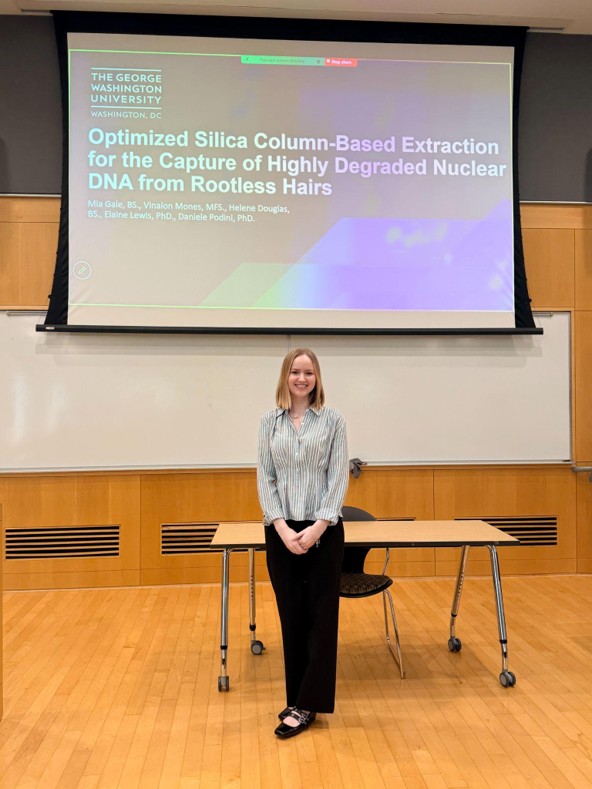
Mia after defending her master’s thesis.
What's the biggest misconception people have about what forensic scientists actually do all day?
The biggest misconception people often have about forensics is that one person handles every step of the process, from examining a crime scene to analyzing a DNA profile. This idea stems from TV shows where characters often do it all. At one point I believed this to be true myself! In the beginning of college, I wanted to do it all: detective, CSI, and lab analyst. I would tell someone beginning in forensics to not worry if they are unsure which area they would like to focus in. The more experience you gain, the clearer your path becomes.
What's the one conversation, session, or experience you'd consider a win when you leave Providence?
A win for me would be getting advice from current analysts and building my professional network. My goal is to make meaningful connections so that future conferences I attend are filled with familiar faces.
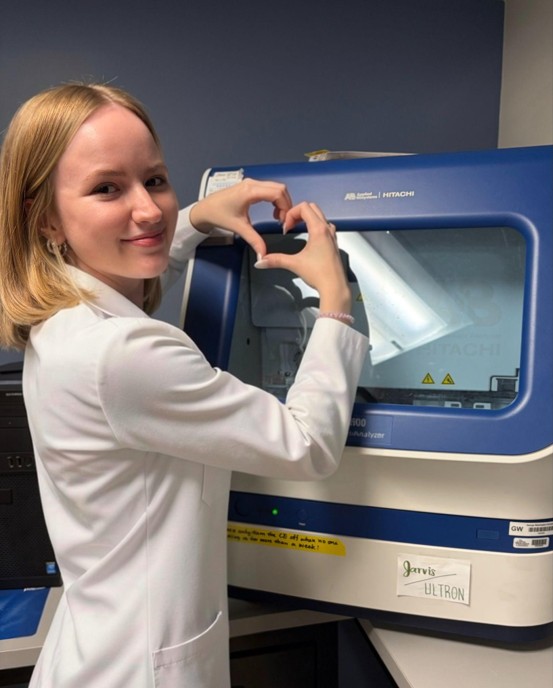
Posing with her most used (and favorite) instrument, the 3500.
What's the best part of lab life that nobody talks about — and the part you're still making peace with?
The best part of lab life is getting to teach others the protocols and methods you use in your research and helping to grow your team. As new students came into the program, I found it very fulfilling to pass the torch onto them and share as many tips and tricks as possible to set them up for success. A part of lab life I am still making peace with is when experiments fail. It is an unavoidable part of the process, but when you are stuck in a rut, it can be hard to keep morale up. But when you finally succeed, it is the best feeling!
What do you want the forensic science community to know about the students walking into this field right now?
The students I have met in this field are incredibly dedicated and supportive of each other. Research can get competitive at times, but my program was full of students who had each other’s best interests in mind and were always willing to help. Additionally, forensics is growing fast, so the more opportunities students have, the more the field will benefit.