
In September 2025, a New York court admitted DNA evidence built from SNP analysis, whole genome sequencing, and rootless hair samples in a criminal trial for the first time in the state’s history.
Getting there took a Frye hearing with nine separate hearing days spread across the spring and summer of 2025. The case itself ended in guilty pleas this spring, not a trial, but the ruling on the evidence still stands, and it’s the one every lab bringing SNP-based forensic genomics into a courtroom next will have to measure itself against.
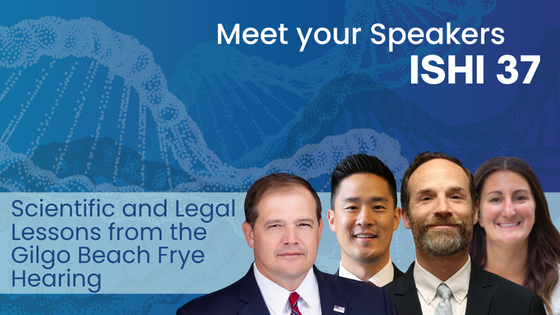
At ISHI 37, four people who lived through that hearing are unpacking it from both the courtroom and the lab: Nicole Novroski, Ph.D., Associate Professor and Associate Director at the Center for Human Identification, University of North Texas Health Science Center; Andrew Lee, Principal Assistant District Attorney, and Nicholas Santomartino, Deputy Bureau Chief of the Cold Case Homicide Task Force, both of the Suffolk County District Attorney’s Office; and Suffolk County District Attorney Raymond Tierney. Their session is called “From Admissibility to Precedent: Scientific and Legal Lessons from the Gilgo Beach Frye Hearing.”
Below, they get into where Frye and Daubert diverge on proving general acceptance, where the science held up under cross-examination, and what a lab should already have in place before its own validation data gets read into the record in front of a judge.
What first drew you to this case, question, or problem?
For well over a decade, the Gilgo Beach murders remained unsolved, prompting local and national fears that an active serial killer was at large. Due to the decomposed and skeletonized condition of the victims, traditional DNA testing (touch, biological, etc.) was not feasible, which caused the investigation to languish.
In March of 2022, just two months into its creation, the Gilgo Beach Homicide Task Force was able to develop Rex Heuermann as a person of interest in the investigation, which begged the question: what could be done to forensically link or exclude Rex A. Heuermann from rootless hairs recovered on multiple victims?
What's the single most important idea you want people to walk away with?
Although rootless hair analysis cannot solve every case, law enforcement and forensic experts should review their cold cases to assess whether there are hairs recovered at the crime scene that could be significant to their investigation. If so, those hairs should be tested with full confidence because not only is the science on your side, but so are the accrediting bodies and now, criminal courts.
What are common misconceptions this talk addresses?
When it comes to SNP DNA analysis in forensics, IGG is the norm and SNP-to-SNP comparisons are the exception. Cases like ours explain why that doesn’t have to be the case moving forward, especially where the investigation already has a person-of-interest.
What's the most interesting or unexpected thing you found doing this work?
While the popularity of SNP DNA testing has rapidly grown in criminal justice over the last decade, its foundation is rooted in decades of science and SNP applications in paleontology, human identification, ancestry, and medical diagnosis. In other words, it’s not “new” science.
Who would benefit most from hearing this talk?
Any stakeholder in the fields of criminal justice and/or human identification.
What's one thing from this talk people can actually use once they're back at work, whether that's a technique, a case example, or a new way of thinking about the evidence?
In light of this case, and the court’s decision after the months-long Frye hearing, hair evidence recovered at crime scenes can no longer be an afterthought.
What are you most looking forward to at ISHI this year, besides your own session?
To see the village of preeminent forensic practitioners in a single room, learning from and encouraging one another to keep this momentum and science moving forward.
What's your best advice for someone attending ISHI for the first time?
For the Suffolk contingency, this is our first time attending ISHI. After we attend this year, we hope to have some sage advice for first timers starting next year!
What do you enjoy doing when you're away from the office/lab?
Some just call them “games,” but the Suffolk team prefers the term “mental fitness,” e.g., Candy Crush, Wordle, and the ultimate brain teaser: trying to understand our children (and for Ray, his grandchildren!)