
Daniel Arend’s biting samples told a clear story: even 16 hours after contact, and after volunteers had gone back to their normal day, DNA from the person of interest was recoverable at near-complete profile quality in most samples. His strangulation samples told a very different one. Skin-to-skin contact produced only partial profiles, often too low to distinguish from the DNA cohabitating partners already leave on each other through ordinary daily contact.
His research builds transfer, persistence, and recovery data for both activities in cases where the people involved already share DNA on each other’s skin from everyday life. That overlap is what makes activity-level evaluation difficult in domestic violence cases: proving DNA is present tells you less than proving how it got there.
Read on for what a good day generating this dataset looks like, the finding that stayed with him longest, and what he hopes forensic scientists take from the distinction between these two activities.
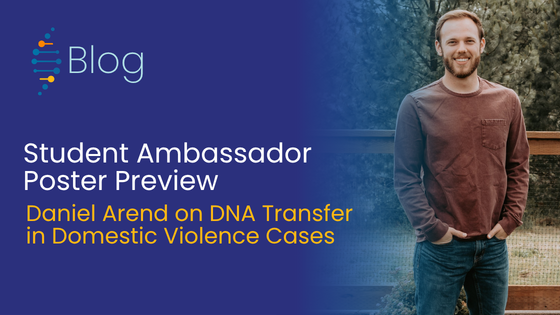
What's the story behind your research — what made you curious about this specific question in the first place?
My interest in DNA transfer, persistence, prevalence, and recovery (DNA-TPPR) and activity-level evaluation began during my undergraduate research, when I started wondering how we could extract more information from DNA evidence beyond simply identifying whose DNA was present. I worked on a project examining whether applied force, impulse, and contact time during strangulation were related to the amount of DNA transferred to the neck. That experience sparked my interest in understanding not just whose DNA is present, but how it may have gotten there, and ultimately led me to continue exploring DNA transfer and activity-level evaluation in graduate school.
Describe your research to someone who hasn't worked in your specific area.
For decades, forensic DNA analysis has been extremely useful for evaluating whose DNA may be present in a sample. Increasingly, however, courts and forensic scientists are also interested in questions such as how the DNA got there and what activity may have resulted in its transfer.
My research examines DNA transferred during two specific activities: biting and strangulation. We compare samples collected up to 16 hours after these activities with background samples from the opposite limb of the volunteer after they went about their normal daily life. We look at factors such as how much DNA from the person of interest is recovered from the other individual’s skin and the composition of the resulting mixed DNA profiles.
By building a dataset under both activity and background conditions, we can apply probabilistic methods to evaluate the DNA evidence under competing propositions, for example, that biting or strangulation occurred versus the individuals simply sharing a living space. Ultimately, this allows us to assess which explanation provides stronger support for the DNA findings we observe.
What's the moment in your research that surprised you most — a result you didn't expect, a method that didn't behave, or a finding that made you rethink everything?
One of the biggest surprises was how clearly the biting samples differed from the background samples collected from the arms. Even up to 16 hours after biting occurred, we recovered nearly complete profiles from the person of interest in many samples, with substantially higher mixture proportions than we observed in the controls.
The person of interest was also often the major contributor to the DNA mixture after biting, whereas they tended to be the minor contributor when biting had not occurred. What made this especially interesting was that participants continued their normal daily activities during that time. I did not expect the distinction between the experimental and background samples to remain so pronounced despite the passage of time and everyday activity.
What does a good day in your research actually look like — and what does a hard one look like?
A good research day is one where I have a long, uninterrupted stretch of time in the lab and can really get into a rhythm. The instruments cooperate, the workflow stays on schedule, and each step of the process moves forward the way it is supposed to. There is something especially satisfying about processing a large batch of samples efficiently, seeing good-quality results come back, and knowing that by the end of the day I have turned another group of samples into data that can actually help answer my research questions. Those are the days when I can focus completely in the lab without constantly switching between classes, meetings, and other responsibilities.
A hard day is almost the opposite. It might involve squeezing an extraction between class and a meeting, troubleshooting unexpected instrument or data issues, and trying to keep multiple responsibilities moving at once. Those are usually the days that end with me working late into the evening, but they are also often the days that teach me the most about problem-solving and adaptability.
What impact do you hope your research will have on the field?
I hope this research will strengthen the body of DNA-TPPR data available for forensically relevant areas of the body while also providing information that can be directly applied to activity-level evaluation in cases involving circumstances similar to those we studied.
Beyond the biting and strangulation experiments themselves, we collected an extensive dataset of background DNA samples from the arms and legs of cohabitating individuals. That information can help us better understand how much DNA, and whose DNA, we would normally expect to find on these areas of the skin during everyday life.
Ultimately, I hope to use this data to help develop more robust methods for evaluating DNA evidence at the activity level so that forensic scientists can more effectively address questions about how DNA may have been deposited, rather than focusing solely on whose DNA is present.
If someone walks away from your poster remembering one thing, what do you want it to be?
I want them to remember that DNA-TPPR data can reveal meaningful and consistent patterns when we compare samples associated with biting or strangulation to normal background DNA.
In our studies, we see greater amounts of DNA from the person of interest on the other individual’s skin following these activities than we typically see in background samples, and the persistence of that DNA follows patterns that we can begin to characterize. Those differences are what make this type of research valuable for moving forensic DNA interpretation beyond the question of “whose DNA is it?” toward the more complex question of “how did it get there?”