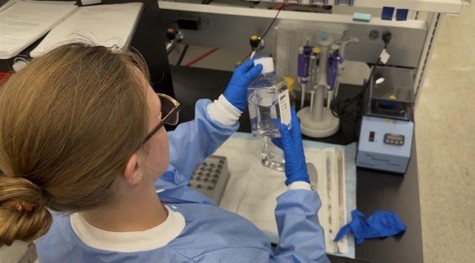
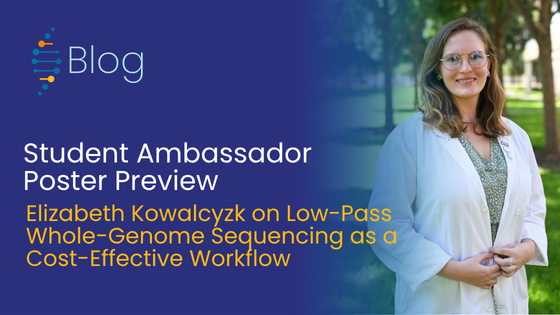
Elizabeth Kowalczyk expected that cutting the sequencing depth would cost her the data. It didn’t. Even at DNA inputs as low as 0.1 nanograms, her low-pass sequencing runs produced genotype accuracies above 99.8%.
Her research asks whether whole-genome sequencing, usually run at a depth and price that puts it out of reach for many forensic labs, can still produce useful forensic information at a fraction of both. Lower-cost benchtop sequencers could open up genome-wide data, including information useful for forensic genetic genealogy, to labs that could never justify a million-dollar instrument.
Read on for what a good day at the bench looks like, the single misplaced comma that once cost her half a day of troubleshooting, and how far she thinks low-pass sequencing could go for the field.
What's the story behind your research — what made you curious about this specific question in the first place?
I have always been interested in forensic science and genetics. I remember learning about the Human Genome Project when I was little and being surprised by how recently it had been completed. The completion of the Human Genome Project opened a whole new frontier for genetics, including whole genome sequencing (WGS). WGS has become increasingly relevant to forensic science due to the vast amount of genetic information that can be obtained from a single assay. Unlike traditional STR analysis, WGS can also provide information that may be useful for applications such as forensic genetic genealogy (FGG). FGG has been used by the forensic community for both perpetrator and victim identification, it was famously used to help identify the Golden State Killer.
As WGS technology has developed, it has also become more accessible and affordable. However, the cost and infrastructure required for WGS can still make it difficult for many forensic laboratories to adopt. That led me to look at low-pass whole-genome sequencing (LPWGS), which generates genome-wide data at a much lower sequencing depth. My research focuses on how much useful forensic information we can obtain from this lower-coverage sequencing data and whether lower-cost benchtop sequencing platforms can produce meaningful results. Ultimately, I am interested in assessing the feasibility of LPWGS workflows for forensic applications and determining whether this approach could provide a more accessible pathway for forensic laboratories interested in adopting WGS.
Describe your research to someone who hasn't worked in your specific area.
Whole-genome sequencing involves sequencing the entire genome, or nearly the entire genome, rather than looking at specific regions of the genome. There are different ways to approach sequencing. High-throughput sequencing instruments can generate enormous amounts of data, but they are also expensive, with some systems costing around $1 million. These instruments can sequence the same position in the genome (e.g., 30 times or 30X), which is referred to as the sequencing depth.
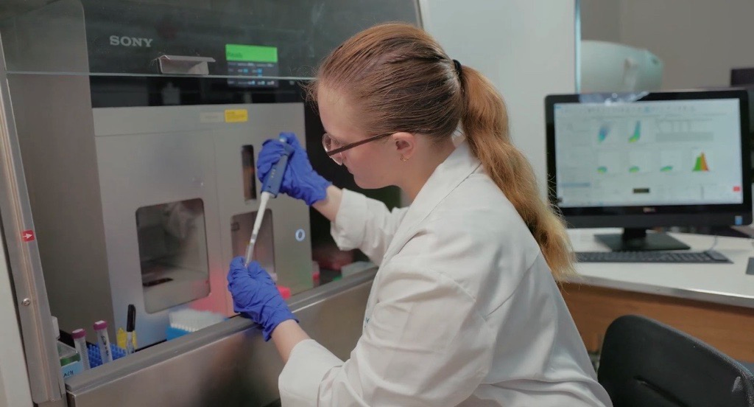
LPWGS takes a different approach. Instead of sequencing each position in the genome multiple times (e.g., 30 or more times), LPWGS sequences each position fewer times, often less than five times. This means you get less data per sample. However, we may be able to process samples using lower-cost sequencing platforms, with initial investments closer to $100,000. Initial exploration of LPWGS protocols have focused on Illumina sequencing platforms, but there are several other benchtop sequencers that could potentially offer LPWGS workflows. My research is exploring the feasibility of using LPWGS on different benchtop sequencing platforms.
What's the moment in your research that surprised you most — a result you didn't expect, a method that didn't behave, or a finding that made you rethink everything?
What surprised me most was how much information we could obtain from low-pass sequencing, especially from samples with very low DNA inputs. I expected that reducing the sequencing depth would result in a much greater loss of useful information than what we actually saw. Rather, the data showed that even when sequencing at a much lower read depth, genotyping, with imputation, produced large, accurate SNV profiles for downstream analyses such as FGG.
What does a good day in your research actually look like — and what does a hard one look like?
A good day usually has me doing some combination of looking at data, working on writing, or preparing samples. It helps prevent burnout from doing the same thing all day. I also have enjoyed learning the process, understanding the basics of each instrument, and contributing to the world of research. Further, I also enjoy the creative side of research; for example, I enjoy figuring out the best way to present data, coding figures, and choosing the colors and styles. On a good day, I can get a figure to work on the first or second try. However, that process also involves coding, and sometimes coding does not go the way you want it to. Sometimes you can spend half a day troubleshooting only to realize the problem was caused by a single comma in the wrong place.
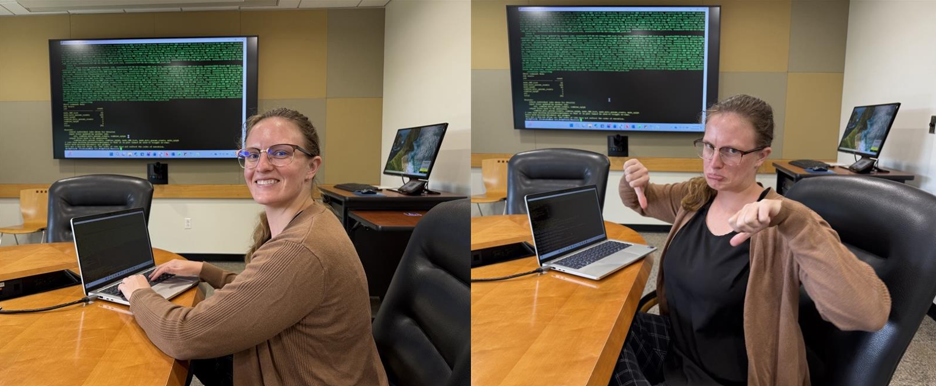
Working in a collaborative environment has a lot of advantages. On a good day, I get to learn so much from the experiences of my coworkers, staff, and faculty. Having people with different areas of expertise is incredibly valuable, and I have learned and grown so much in the time I have been here. However, research rarely happens in isolation, so sometimes you have to balance your own experiments, deadlines, and timelines with everyone else’s. On a bad day, that can get overwhelming or a little chaotic. On rare occasions this has led me to a couple of late nights in the lab.
A good day also looks like taking time for oneself outside of the lab. To be the best researcher, you also have to be your best self; for myself, this means setting time aside for friends, family, gardening, and creative pursuits.
What impact do you hope your research will have on the field?
One of the most important impacts of this project is establishing the feasibility of using low-pass whole-genome sequencing on different benchtop sequencing platforms. My work is helping establish a proof of concept.
If we can demonstrate that useful forensic information can be recovered from lower-cost, low-pass WGS workflows, it could help make genome-wide sequencing a more realistic option for laboratories that may not have access to larger, higher-throughput sequencing systems.
If someone walks away from your poster remembering one thing, what do you want it to be?
I hope that anyone who stops by my poster will see the benefits of exploring low-pass whole-genome sequencing. LPWGS may provide a more accessible path forward for forensic laboratories interested in adopting whole-genome sequencing without the same upfront investment required for high-throughput sequencing systems. You don’t always need the most expensive instrument or the highest sequencing depth to get useful information, so lets see just how low we can go.