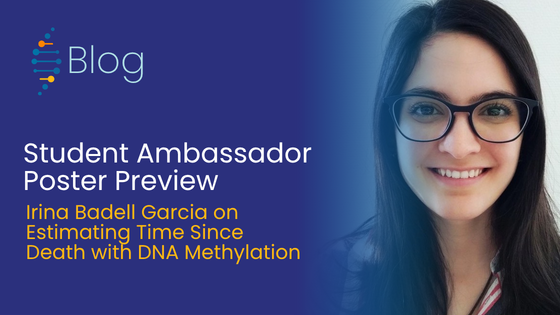
Irina Badell Garcia knew her way around CODIS STRs and mitochondrial kinship testing before her PhD even started. Then her advisor, Dr. Aaron Shafer, asked her to learn something she’d never touched: DNA methylation, at a taphonomic research facility that doesn’t have a counterpart anywhere else in Canada.
Her research asks whether the chemical marks that build up on DNA over time can do more than confirm identity. Using soft tissue samples collected up to three years post-mortem, she’s testing whether those marks can estimate age, sex, and time since death, even in cases with no other leads.
Read on for how she got there, what surprised her most, and what she hopes people remember when they walk away from her poster.
What's the story behind your research — what made you curious about this specific question in the first place?
This project focuses on identifying DNA methylation (DNAm) patterns in a post-mortem context, which is a largely unexplored topic. When the opportunity came up to work with my wonderful supervisor, Dr. Aaron Shafer, and to collaborate with Dr. Shari Forbes in the first and only taphonomic facility in Canada (REST), it was clear that I wanted to get involved. Although I had worked in forensic genetics before using CODIS STRs to identify ancient remains and mitochondrial DNA to establish kinship, DNAm was completely new to me. The learning curve was steep, but ultimately, I find it very rewarding to learn new methods and grow that way as a researcher.
Describe your research to someone who hasn't worked in your specific area.
My current research focuses on DNA methylation (DNAm) as a potential new tool in investigative forensics. Methylation is the addition of a small chemical group, a methyl (—CH3), to Cytosine (C), one of the four bases that DNA is composed of. Illumina technology allows us to know the methylation levels of 930K of these Cs all throughout the human genome. The main goals of the project can be divided in two:
- Can DNAm provide phenotypic information about the donor of the biological sample? There is extensive literature with known epigenetic markers for age, sex, and lifestyle traits, such as smoking, alcohol consumption, BMI, etc. For this, I have selected certain Cytosines, whose methylation levels correlate with these traits, and I’ve used them to estimate the traits during a post-mortem interval (PMI) of ~3 years.
- Can DNAm estimate the PMI itself? Estimating the time or day of death when there are no investigative leads is one of the biggest challenges in forensics nowadays. DNAm is used in alive individuals to estimate their chronological age, and we have successfully estimated age post-mortem as well, this evidencing the potential of DNAm as reliable marker for the passing of time. Therefore, we’ve built a PMI prediction model based on methylation levels from soft tissue.
The ultimate goal of the project is to be able to extract as much information possible from a biological sample to aid in identifying its donor. Traditional DNA typing methods are invaluable for establishing identity, but they can’t provide information about characteristics and life-history of the donor. This could help police identify a suspect or unknown victim of a crime, as well as to rule people out; it could provide closure in cases of historical memory and mass disasters and aid in disaster victim identification (DVI) efforts.
What's the moment in your research that surprised you most — a result you didn't expect, a method that didn't behave, or a finding that made you rethink everything?
I have to admit that the lack of knowledge we have about decomposition surprised me. When I started working on a literature review in the early days of my PhD I was a little shocked to find fewer publications than I expected about human decomposition. Considering how long humans have been dying for, we only started studying the decay process very recently, maybe due to social stigma, lack of funding and ethical constraints. Additionally, most of the studies have been done in temperate climates, which leaves a big knowledge gap in other climates, such as the humid continental where my study took place.
What does a good day in your research actually look like — and what does a hard one look like?
In general, no matter if I’m in the field, lab, or analyzing data, a good day for me is when everything goes smoothly. The samples are easy to collect and no mosquitos or flies bite me, the lab equipment runs smoothly and Rstudio doesn’t give me any error messages. When the complete opposite happens, it’s not automatically a bad day, but it can turn into one if several things go wrong and I don’t achieve what I had set myself to do that day. Thankfully, I’ve never had things go wrong in the field, lab and computer on the same day!
What impact do you hope your research will have on the field?
This project aims to expand the information that can be obtained from biological evidence in forensic investigations. While traditional DNA profiling is very good at establishing identity, DNAm has the potential to provide additional information about the donor, which would prove invaluable for cases in which a DNA profile can’t be obtained or it provides no matches in the available databases. The ultimate impact is to develop complementary molecular tools that can provide investigators with additional leads, resulting in a narrower search for a suspect or aiding in the identification of a victim.
If someone walks away from your poster remembering one thing, what do you want it to be?
A biological sample can tell us more than just who someone is. It can tell us about the individual behind the DNA. And if they’re impressed enough to hire me to continue this work after graduation, that would be a nice bonus!