
As we begin planning for the next ISHI, we’re excited to welcome new voices to the Advisory Committee. These members bring fresh insight, deep expertise, and a shared commitment to moving forensic science forward.
We also want to express our heartfelt thanks to those rotating off the committee. Your ideas and input have helped shape ISHI into the dynamic, inclusive community it is today.
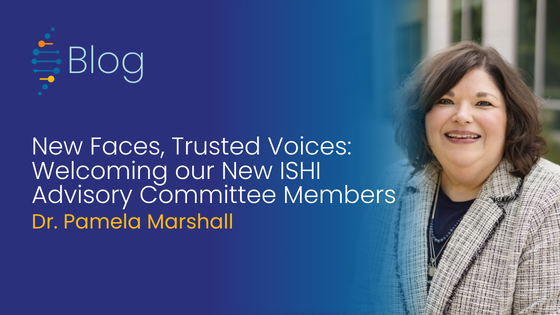
We’re thrilled to officially welcome Dr. Pamela Marshall to the ISHI Advisory Committee—an educator, mentor, and leader whose passion for forensic science and student empowerment is both infectious and inspiring.
From watching the O.J. Simpson trial in her college years to leading the nation’s only FEPAC-accredited entry-level forensic master’s program, Dr. Pamela Marshall has always followed the science—and brought others along with her. Whether she’s guiding students, advancing ethical conversations in DNA technology, or shaping the field’s next chapter, Pam brings clarity, energy, and a deep belief in the power of education.
In this Q&A, Pam reflects on her journey from the lab bench to the classroom, what excites her about the future of forensic DNA, and the impact she hopes to make as part of ISHI’s Advisory Committee.
What drew you to the field of forensic science, and how has your journey shaped your perspective on where the field is headed?
I still remember racing home from my pre-med/biology courses during college when the O.J. Simpson trial aired. It was the first time I had ever seen a case televised from start to verdict, and I was captivated, not by the drama, but by the science. Watching Dr. Henry Lee and Dr. Robin Cotton explain complex evidence to a jury was a revelation. It showed me that science (the good, bad, and ugly) could directly impact justice. That moment changed my career path.
Since then, I’ve learned that forensic science is a living, breathing discipline, and students are at the heart of that evolution. They bring fresh ideas, new perspectives, and a passion for innovation. The future of the field depends on how well we prepare and empower them. Looking forward, I see the field embracing automation, artificial intelligence, and global collaboration, but always with a commitment to transparency and ethical responsibility.
In your opinion, what is the most pressing challenge facing forensic DNA today—and what role can ISHI play in addressing it?
One major challenge is balancing rapid technological advancement with ethical responsibility, especially around privacy, consent, data security, and genetic genealogy. ISHI is uniquely positioned to lead these conversations by creating spaces where students and professionals learn together, discuss these issues openly, and develop solutions that prioritize both innovation and integrity. Giving students a seat at that table ensures the next generation is ready to tackle these challenges.
What innovations or tools are you most excited to see impacting the forensic field in the next 5–10 years?
I’m thrilled about rapid DNA technology and the potential of AI-driven tools and algorithms. Imagine being able to process complex mixtures in minutes or deploy portable sequencing platforms in the field without sacrificing quality, reproducibility, and accuracy. These innovations will not only speed up investigations but also democratize access to forensic capabilities worldwide. And, I get so excited seeing students learn these tools early because they’ll be the ones to refine and expand their use in ways we can’t yet imagine.
What’s a case, project, or moment in your career that fundamentally changed the way you think about forensic science?
Early in my career, I worked on a case with very limited evidence involving severely degraded DNA – it was humbling. We often think of science as definitive, but that case reminded me that uncertainty is part of the process. It taught me the importance of transparency – communicating limitations clearly and ensuring that stakeholders, including law enforcement and lawyers, understand what the science can and cannot say. That experience also shaped how I teach students today: not just the science, but the responsibility that comes with it.
From your perspective, what makes ISHI unique among forensic conferences?
ISHI feels less like a conference and more like a community of learners. Its where cutting-edge research meets practical application, and where collaboration thrives. It brings together global experts and students in the same space, fostering mentorship and collaboration. That inclusivity is rare and powerful. The energy is palpable – you leave not just with new knowledge, but with new connections and ideas that shape the future of the field.
And, you leave inspired, re-energized, and already looking ahead to the next ISHI!!
As a new member of ISHI’s Advisory Committee, what impact do you hope to make, and what do you hope ISHI continues to do for the global forensic community?
I want to help ensure that students have a voice in shaping the future of forensic science. They are the next generation of innovators, and the legacy we leave behind will be carried forward by them. My hope is that ISHI continues to expand its global reach – not only providing education and resources to practitioners but also creating meaningful opportunities for students to engage, learn, and contribute. Forensic science is a universal language, and ISHI helps us speak it together across generations.